II. The National Revival Period
1
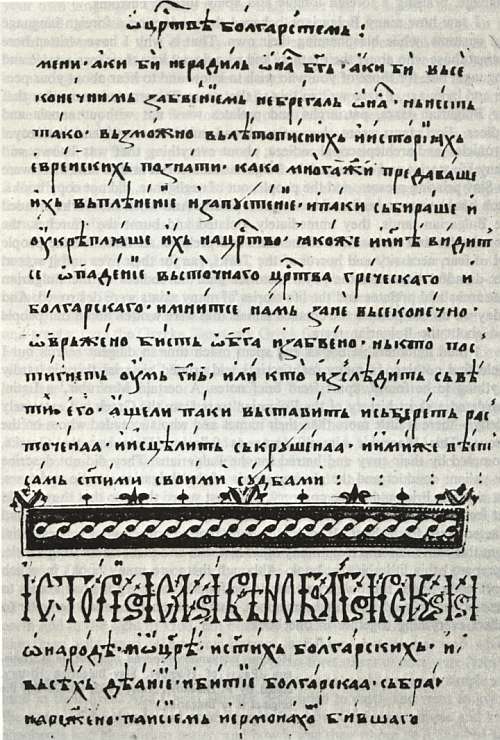
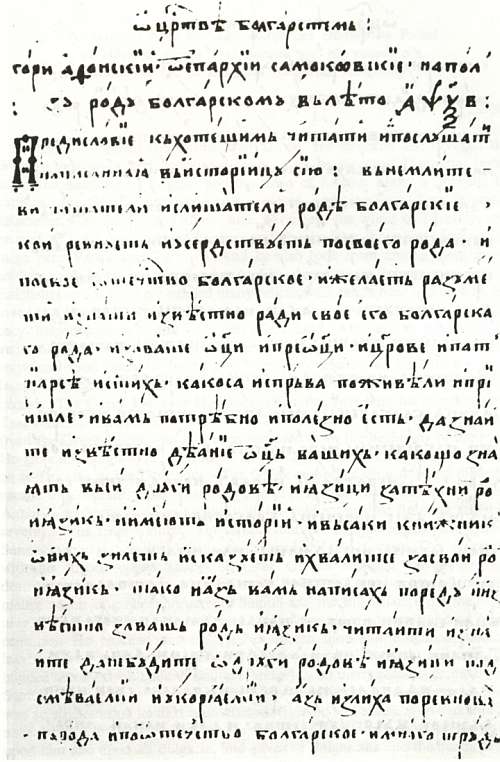
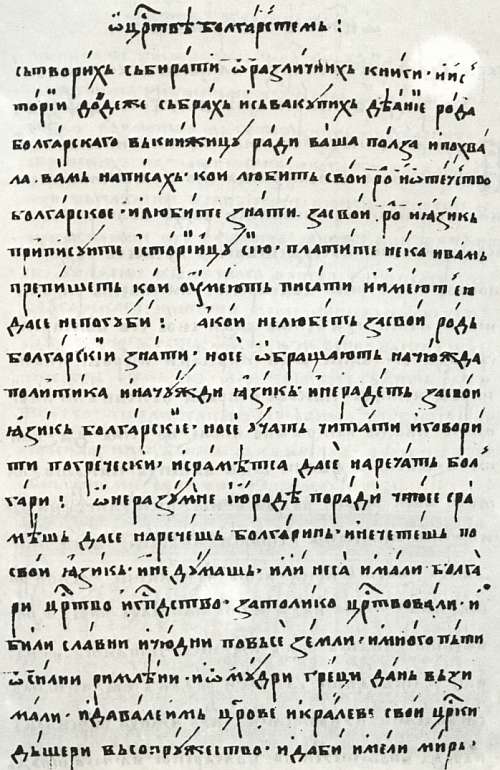
An excerpt from the foreword to A Slav-Bulgarian History by Paissi of Hilendar 1
emphasizing the necessity of knowing the history of one's country
Hearken, О you readers and listeners, you Bulgarian people, who love and hold dear your kin and your Bulgarian homeland and wish to understand and know what is known about your Bulgarian kin and about your fathers, and forefathers, and the tsars, patriarchs and saints, how they lived and what they did. For you it is necessary and useful to know what is already known about the deeds of your fathers, just as all other tribes and peoples know about their kin and their tongue; they have their own history and every literate man knows and relates this history and is proud of his kin and tongue.
Therefore I, too, have
written
down
for you in sequence that which is already known about your kin and your
tongue.
Read it and acquaint yourselves with it, so that you will not be
ridiculed and
reproached by other tribes and peoples. I love the Bulgarian people and
my country
very much and with much labour have I collected material from various
books and
histories until I collected and brought together the deeds of the
Bulgarian
people in this little book for your benefit and praise. I wrote it for
you, who
love your people and the Bulgarian land and who wish to know about your
kin and
tongue. Copy this little history book and pay those who know how to
write to
copy it for you and take good care that it is not lost.
And some there be who do
not
wish
to know about their Bulgarian kin and turn to a foreign culture and to
a
foreign tongue and do not care for their Bulgarian language, but learn
how to
read and speak Greek and are ashamed to call themselves Bulgarians. O,
senseless and foolish ones! Why are you ashamed to call yourselves
Bulgarians
and why do you not read and speak your
own language? Or
have not the Bulgarians had a kingdom and a state? Long did they reign
and long
were they glorious and famous throughout the world, and many a time did
they
exact taxes from the powerful Romans and from the wise Greeks. And
emperors and
kings gave them their royal daughters in marriage, in order to live in
peace
and love with the Bulgarian tsars. The Bulgarians were the most famous
of all
the Slav peoples, they were the first to have tsars, they were the
first to
have a patriarch, they were the first to be converted to the
Christian faith
and it was they who conquered the most land. Thus, of all the Slav
people, they
were the strongest and most respected, and the first Slav saints shone
forth
from the Bulgarian people, speaking the Bulgarian language, as I have
duly
written in this history. And about this, too, the Bulgarians have
evidence from
many histories, because this is the truth about the Bulgarians, as I
have said.
O, you stupid men, why are
you
ashamed of your kin and why do you hanker after a foreign language?
But, you
will say, the Greeks are wiser and more cultured, whereas the
Bulgarians are
simple and stupid and have no refined words. That is why, you will say,
it would
be better if we followed their lead. But see here, you senseless ones,
there
are many peoples that are wiser and greater than the Greeks. Does any
Greek
forsake his tongue and his people as you, О witless ones, forsake
yours, while gaining nothing from Greek wisdom and refinement? Be not
deceived,
О Bulgarian, know your people and language and
learn in
your own tongue! Better is Bulgarian simplicity and kindness. The
simple
Bulgarians welcome all to their homes and entertain them, and they give
alms to
those who beg of them. Whereas the wise and cultured /Greeks/ never do
this,
but instead they take from the simple and rob them unjustly, so
that sin
rather than benefit results from their wisdom and culture. Or maybe you
feel
ashamed of your own people and language in the presence of the learned
and the
merchants, and the famed ones of this earth, because the Bulgarians are
simple
people and there are among them few merchants and literate men, or such
that
are skilled and famous on this earth today, because the majority of
them are
ordinary ploughmen, diggers, shepherds and simple artisans? I shall
answer you
briefly on the question. From Adam to David and to Joachim the
Righteous One,
to Joseph the Betrothed (to the Holy Virgin), of all the righteous and
holy
prophets and patriarchs, called great both on this earth and in the
sight of
God, not one was a merchant or a sly and proud man like these wily ones
whom
you respect, at whom you marvel and whose customs and language you ape.
All
those pious forefathers of ours were farmers and shepherds, rich in
livestock
and the fruits of the earth, and were simple and kind in their lives.
And
Christ Himself descended to earth and went to live in the home of the
simple
and poor Joseph. See how God loves simple and kind shepherds and
ploughmen
better, and how it was they whom he first loved and glorified on earth,
and yet
you feel ashamed because the Bulgarians are simple and guileless
shepherds and
ploughmen, and you forsake your own people and language,
praising a foreign tongue and aping foreign customs.
I saw how many Bulgarians
behaved
thus, adopting a foreign language and customs, while blaspheming their
own.
That is why I have written here against those who abuse their fathers
and who
do not love their own people and language; but, for those of you who
wish to
know and to hear about your people and language, I have written
this so that
you will learn and remember that our Bulgarian tsars, patriarchs and
prelates
were not without annals and codices. For many years they reigned and
ruled on
earth and had royal chronicles and archiepiscopal codices; about
everything
that was known and many life-stories and canons of the Bulgarian
saints. But at
that time there were no Slav printing presses, and the people, out of
negligence, did not copy books. Such books were to be found in very few
places.
And when the Turks invaded the Bulgarian lands, they immediately
violated and
burnt the churches, the monasteries and the palaces of the tsars and
prelates.
At that time the people out of fear, necessity and horror of the Turks,
ran for
their lives and it was at this dreadful time that the royal histories
and the
codices of the Bulgarian patriarchs and prelates and the life-stories
of many
saints were destroyed. And today we do not possess the detailed annals
that
were written about our people and about the Bulgarian tsars.
I read innumerable books
and
spent
much time in diligent search but I could find nothing. In many
manuscripts and
printed histories there is hardly anything to be found, apart from
brief notes.
A certain Mavrubir,2 a Latin, translated a
short history of the Bulgarian tsars from the Greek but extremely
briefly — there is little more than their names and who
succeeded whom on the
throne. This Mavrubir himself wrote as follows: 'Thus say the Greeks,
prompted
by their envy and hatred for the Bulgarians. They did not describe the
valiant
conduct and the glorious deeds of the Bulgarian people and tsars, but
wrote in
brief and to the contrary, as it best suited them so that they would
not feel
ashamed that the Bulgarians had many a time defeated them and had
exacted taxes
from them.' It took me a long time to collect what was essential from
this
Mavrubir and from many other histories and then, elaborating a little,
I
prepared this little history book. Although there are many books in
which short
notes about the Bulgarians are to be found, not everyone has access to
these
books, to read them and remember, thus I reasoned it would be better to
collect
everything together in one book.
История славяноболгарская, под ред. на П. Динеков (Paissi of Hilendar, Slav-Bulgarian History, edited by P. Dinekov), Sofia, 1963, pp. 29-30; the original is in Bulgarian
1 Paissi of Hilendar, born in Bansko in 1722, first ideologist of the Bulgarian National Revival. In 1762 he wrote the Slav-Bulgarian History, which represents the beginning of modern Bulgarian literature. Recopied and circulated in villages and towns, it awakened and strengthened Bulgarian national consciousness
2 Mavro Orbini, author of The Kingdom of the Slavs (1601), a source used by Paissi of Hilendar
2
An excerpt from the Slav-Bulgarian History by Paissi of Hilendar
about Tsar Samuil and his successors, and the fall of the First Bulgarian Kingdom
Samuil ascended the throne after David. He attacked and ravaged the Western provinces and conquered them. And he attacked Dalmatia, burnt down the outskirts of Ragusa and the town of Katara. Many a time did he vanquish the Greeks, cut their forces to pieces and take from them Salonica, Enisheher, Karaferia, i. e. Larissa, and Berrhoea, the whole of Thessaly, and he sent off the Kutsovlahs, Albanians and Greeks from those parts and settled them near Varna and Turnovo. And he also took from among them many soldiers to fight against the Greeks. And he placed many Bulgarian soldiers in Enisheher and from there carried many relics of the saints over to Bulgaria. He loved and honoured with great reverence the holy relics, and so at the beginning they helped him win and conquer much land. And at the beginning he venerated God and the saints, and God also helped him. Then he turned to evil ways and God foresook him. He rose in envy against his kin and the royal family and he slew them all. He spared only Ivan Vladislav, the son of his brother. The Greek Emperor Nicephorus Uranius rose with his forces against Tsar Samuil, vanquished and wounded him in battle. He returned home and freed the Greek rulers who had been enslaved from the beginning of the wars. He gave his daughter in marriage to the Greek General Azotus and made him go to Duratsa or the Dobroudja. The Greek embarked on a ship and made his escape to Constantinople. There the title of Magister was bestowed upon him. Again Nicephorus Uranius set out with his soldiers against Bulgaria and took several towns from Samuil. The Greeks marched against Skopje and Serbia, Samuil started out against Edirne, he ravaged and laid it waste. Then he set out with his forces against Skopje, but the Greeks besieged his soldiers and destroyed them. And they enslaved many Bulgarians and because of the great malice which king Nicephorus bore Samuil and the Bulgarians from the beginning, Emperor Nicephorus subjected the soldiers to a torture unheard of for centuries. He plucked out the eyes of fifteen thousand Bulgarian soldiers, leaving a one-eyed man in every one hundred soldiers to lead them, and thus blinded he sent them back to Samuil. And when so many soldiers came to Tsar Samuil, and when he saw so much Bulgarian suffering and misery, his heart was so stricken that he died soon afterwards. And so Samuil, who had shed innocent blood killing his royal kin, angered God and God poured all his wrath upon him and upon all Bulgaria, and gave the Bulgarians into the hands of the Greeks for a long time to come, as it will be said later on.
After Samuil, his son
Radomir
came
to the throne, but he reigned only for one year and on the instigation
of the
Greek Emperor Nicephorus was slain while hunting. Nicephorus had
secretly sent
a man who killed him during the chase.
After Radomir, Ivan
Vladimir
ascended the throne. The Bulgarians banished Gavrail, Samuil’s son, to
Wallachia and made Ivan,
Aaron's son, king.
Aaron
was Samuil's and David's brother. St Ivan Vladimir reigned for three
years,
leading a pure, holy and pious life at first. The Greek Emperor rose
once more
against Ivan with a mighty force, but with a prayer to God and filled
with
great hope, he went with a small army and vanquished the Greeks. And
then they
returned in shame. But Ivan had a Greek wife and brother-in-law with
him with
the rank of Magister. He and his sister were heretics, novationists,
they did
not love the saintly Tsar Vladimir because of his Orthodoxy and pious
life and
laid a snare to kill him. Ivan's brother-in-law himself slew him as he
passed
through a forest, he cut off his head as he was riding his horse. It
was God's
will that Ivan should not fall off the horse, but take his own head in
his
hands and spur on his horse. He passed through many places and arrived
at the
monastery, which he had built himself at the beginning: there he
dismounted his
horse and expired. And it is in this monastery in Elbasan country that
Ivan's
relics rest immortal and whole and cure many illnesses. The entire
region commemorates
him on the 22nd of May. He is a saint and a special fine service, well
appointed, with a vigil and doxology, is held with great solemnity and
glorification. Here we have briefly written about the saintly Tsar
Ivan-Vladimir. This saint's life and service have been translated into
Greek,
but quite incorrectly: the life was either written later, after a
long time,
or some Serbian or Greek has changed it, wanting to hide his Bulgarian
origin,
that he comes from a line of Bulgarian tsars. They wrote that he was of
Serbian
origin, the son of Neman Simeonov, but they were gravely mistaken, they
did not
know the years in which Simeon of Serbia reigned. At that time there
were no
kings at all in Serbia, let alone tsars. Simeon Neman and his sons were
kings
many years later, and we know about all the holy Serbian kings, it is
written
where each died and where their relics and graves are to be found. If
you look
at the Serbian family-tree you will find out at what time Samuil
and Simeon
and St Ivan-Vladimir lived and you will see how the writers were
mistaken in
this or wanted to conceal the origin and homeland of St Ivan-Vladimir.
After the murder of Ivan,
the
Greek
Emperor entered Ohrid without resistance. St Ivan had spent three years
of his
reign there in Ohrid. And those murderers surrendered all Bulgaria to
the Greek
Emperor. Without resistance he arrived, opened the treasury and the
royal
treasure, carried off a lot of gold and countless amounts of silver and
divided
them among his soldiers. He took many royal wreaths, crowns and
precious
stones. He had great mercy on Tsarina Maria, the wife of Tsar Ivan, and
on
their five daughters. And he knew that she had surrendered the
Bulgarian
kingdom and had killed her husband.
And then from Turnovo came
Patriarch David and two Bulgarian barons Bogdan and Mirobizo, they
brought the
keys to the thirty-five Bulgarian towns and handed the keys and the
towns over
to the Greek king. He put Mirobizo and Bogdan again as barons of
Bulgaria. And
so the Bulgarian kingdom finally fell under Greek rule because of the
sin of
Samuil, the Bulgarian tsar and because of the novationist and Armenian
heresy
which multiplied among the Bulgarians in the Ohrid country.
Паисий Хилендарски, История славяноболгарская под редакцията на П. Динеков (Paissi of Hilendar, Slav -Bulgarian History, edited by P. Dinekov), Sofia, 1963, pp. 46 48; the original is in Bulgarian
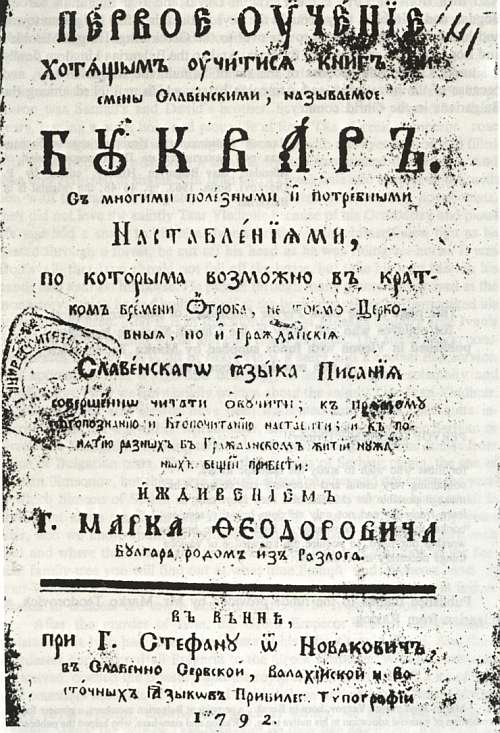
Title page of the book Pervoe Ouchenie, or Boukvar (Primer) for children who will study hi the Church-Slavonic language,
published in Vienna with funds supplied by Marko Teodorovich1, a rich merchant from Razlog
for those who wish to study the Slavonic letters,
containing very useful and necessary instructions, which
make it possible for children in a very short time to
learn freely to read not only religious but also secular
books; to gain true knowledge of God, to learn how to
worship our Lord, to acquire the knowledge of various
things necessary in secular life.
1 Marko Teodorovich Vezyov, born in Bansko, a prominent Bulgarian merchant, a pioneer for the introduction of national education in his native town, in Razlog and elsewhere, who helped the publication of Bulgarian books and teaching programmes. He was in the diplomatic service with the Serbian Prince Karageorgi
................................
The Bulgarian Yano Mitre, (v.) Kariptsi, Langadas (today the village of Hloronomi, Salonica district), on embracing Islam was named Hassan.
29 Shaban 1211 (28.1.1797)
The Bulgarian Stoyan Mitre from Enidje Vardar (today the town of Yanitsa), on embracing Islam was named Mehmed.
25 Ramadan 1211 (24.Ш.1797)
The Bulgarian Itsko Petko from Enidje Vardar, on embracing Islam was named Ismail.
3 Shavval 1211 (1.11.1797)
The Bulgarian Vassil Stoli from (v.) Sveta Paraskeva, Kalimeria (today the village of Kalamaria), on embracing Islam was named Husein.
11 Shavval 1211 (9. IV.1797)
The Greek Georgi Stamat from (v.) Zarova (today the village of Nikopolis, Langadas), on embracing Islam was named Ali.
25 Rabia I 1212 (17.IX.1797)
Йорданка Калудова, Документи за положението на населението в югозападните български земи под турска власт (Yordanka Kaloudova, Documents on the situation of the population in the southwestern Bulgarian lands under Turkish rule), ВИС, 4, 1970, p. 72; the original is in Turkish
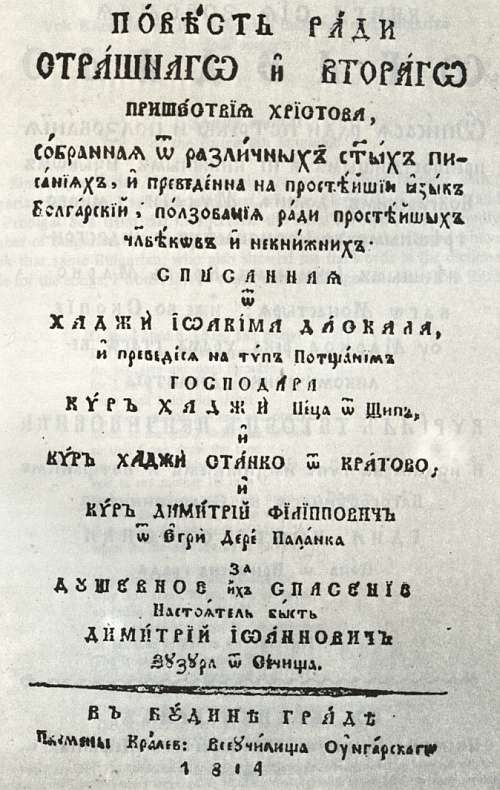
Title page of die book Story of the Terrible and Second Coming of Christ,
translated into ‘the simplest Bulgarian’ by Joakim Kurchovski1 and printed in Budapest
Coming of Christ, collected from
different Holy Writings and translated
into the simplest Bulgarian, for the
use of ordinary and uneducated people.
Written by Hadji Joakim, the Schoolmaster,
and printed through the benevolence of
the honourable masters Mr. Hadji Stanko
from Kratovo and Mr. Dimitri Filipovich
from Kriva Palanka for the salvation of
their souls. Dimitri Yoanovich Zuzura
from Sechishte was trustee. In the town
of Buda, Royal Hungarian University.
1 Joakim Kurchovski (с. 1750-С.1820), born in the village of Oslomevi, Kichevo (Kurchovo) district, Bulgarian scholar, teacher and priest, author of moralizing books such as The Story of the Terrible and Second Coming of Christ, This Book Which Tells About Trials and Tribulations, etc.
6
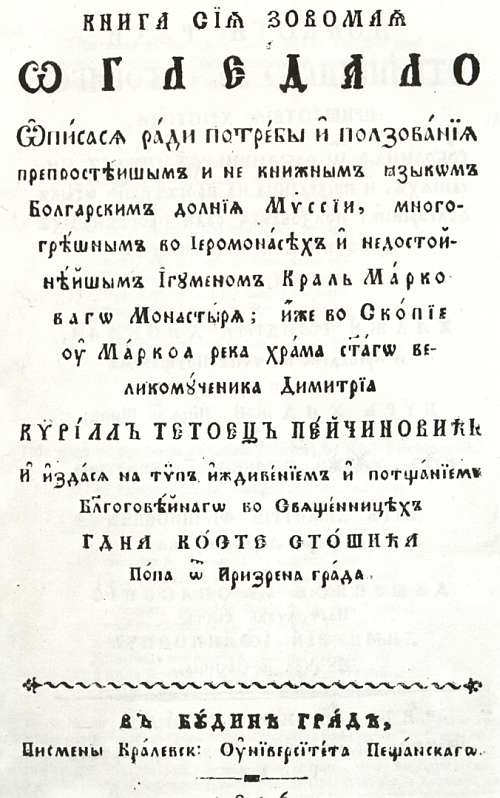
Tide page of the book Ogledalo (Mirror) by Kiril Peichinovich,1 compiled in
'the simplest, non-literary Bulgarian, of Lower Moesia' and printed in Budapest
need and for the use in the simplest, non-
literary Bulgarian of Lower Moesia, by the most
sinful monk and unworthy abbot of the Kral Markov
Monastery, located in Skopje by the river Markova
near the church of the holy martyr Dimitri,
Kiril Tetovets Peichinovich, and is printed through
the funds and benevolence of the Reverend Mr.
Kosta Stoshich, a priest from the town of Prizren.
In the town of Buda, Royal Pest University.
1Kiril Peichinovich (1771-1845), born in the village of Teartse, Tetovo district, Bulgarian scholar, abbot of the monasteries of St Demetrius (south of Skopje)' (1801-1818) and St Athanasius, near the village of Leshok (1816). He published This Book Called Mirror, Book about the Consolation of Sinners, etc., written in the spoken language of the people, which also deal with questions related to the everyday life of the Bulgarian people
of the Bulgarian language
Since, even today, learned people are only slightly familiar with the Bulgarian language, I will here add, first, the parables of the Samaritan and of the Prodigal Son from the Gospel and the Lord's Prayer, and secondly, a number of Bulgarian folk songs. For the translation from the Gospel I have to thank that same Bulgarian, who also showed me the words in the dictionary, while for the songs, I would like to thank another Bulgarian, also from Razlog.
O, thou maiden, young and pretty!
Do not cross my courtyard,
do not give me more throubles,
for I have enough of mine,
what shall I do with thine!
О, thou maiden, young and pretty!
Look at me and I shall look at thee
so that I can draw thy face
on a sheet of white Turkish paper,
and to my mother I'll take it
that she may see with what maid I've fallen in love,
slender like a sapling in the woods
in Spring, in the month of May,
when the flowers are all in bloom.
Hey, thou forest, thou greenwood,
why dost thou, forest, look so faded,
so faded and so withered?
Is it because the frost has seared thee
or because a fire has scorched thee? -
The frost has not seared me,
neither has a fire scorched me,
only my heart with pain is burning:
Three groups of slaves in chains passed by yesterday:
The first group were all young Greek maidens,
and they passed by and were weeping:
where, oh, where is now our wealth?
The second group were all dark-eyed Wallachian maidens,
they came by and were weeping: Oh, our dear Wallachian gold coins!
The third group were all young Bulgarian women,
and they went by and were weeping: O, our dear fatherland.
O, our dear young little sons!
1. It may be that some of the above
songs are not
complete or that in many of them the lines are not equally long (there
are
fewer or more syllables); but we hope that the readers will forgive us
these
errors, especially when they bear in mind the fact that these Bulgarian
songs
were both written in Vienna, and that here more attention is given to
grammar
than to poetry. But when, by the will of God, the time comes for
Bulgarian
songs to be collected in Bulgaria as well and to be written down from
the lips
of the singers’ themselves, then these errors will be corrected and
everything
will be put right. From these few songs, it will be seen that Bulgarian
songs
are similar to Serbian ones and that, in all probability, there must be
as many
of them, as are the Serbian songs (in proportion to the population).
The songs
which the Serbian kratitsi sing on Trinity Sunday, are sung by
Bulgarian
girls on St John's Day, January 7th, and the last two little songs
belong to
this group. Bulgarians also have their popular hero-songs, which are
sung to
the rebec, like the Serbian ones, and, what is more, there may be a
great
many Serbian songs adapted to the
Bulgarian language, for the Bulgarians themselves admit this to be true
in the
case of some of the above songs (for example, 15
and 25). In the Bulgarian songs, as in the Serbian ones,
there are words which
today can be heard only in songs, for example, 'hartya' (in the spoken
language
they say 'kniga'), 'zheltitsa' (in the spoken language 'zhutitsa'),
'konya' (in
the spoken language 'kone’),etc.
2. From these short examples every
philologist will at
once notice the main difference which distinguishes the Bulgarian
language from
the other Slav dialects, and this is: a) the article (Artikel), which
is added
to the end, for example 'krachmarnitsata', 'utreto', 'hlebo',
etc., and, b)
the fact that the nouns have almost no declensions, for example, ‘za
toya
chovek, ot Yerusalim, kray more, na kon, ot kon, nyamam voda’, etc.
So far I have only three
Bulgarian
books: a) Malka knizhitsa (in octavo) о
mitarstvima;
I saw
this booklet in Serbia last year but I do not have it with me now, so I
can say
nothing about it (I think it was printed in Budim). b) Razlichna
pouchitelna
nastavlenja, sochinenya Yeromonahom Yoakimom Hadji, in Budim, 1819. This book was seemingly written in the Bulgarian
language, but actually it is not Bulgarian, nor Russian, nor Slavonic,
but a
mixture of all three of these languages. etc. by
the teacher and priest Danil of Moscopol,
first printed in Moscopol 60 years ago and then
reprinted in 1802 in Dubrovnik. In this little book
one can find several dialects: Greek, Wallachian, Bulgarian and
Albanian, which
were written with the intention of making these peoples forsake their
'barbarian languages and become Greeks'. Perhaps in this phrase-book
the
Bulgarian language is purer than in previously written books, but the
words,
rendered in Greek letters, are so erroneously written (how otherwise,
than
wrongly, could the Slav words be rendered in Greek letters), that this
book, too,
cannot be used in a proper way.
etc. by
the teacher and priest Danil of Moscopol,
first printed in Moscopol 60 years ago and then
reprinted in 1802 in Dubrovnik. In this little book
one can find several dialects: Greek, Wallachian, Bulgarian and
Albanian, which
were written with the intention of making these peoples forsake their
'barbarian languages and become Greeks'. Perhaps in this phrase-book
the
Bulgarian language is purer than in previously written books, but the
words,
rendered in Greek letters, are so erroneously written (how otherwise,
than
wrongly, could the Slav words be rendered in Greek letters), that this
book, too,
cannot be used in a proper way.
From „Додатак к Санктпетербургским сравнительним рjечницима свиjу езика и наречиjа с особитим огледима бугарског jезика". Беч, 1822. (cf. „Религиозни разкази", № 11-12, November, December 1897, pp. 740. 751,. 752, 757-759) the original is in Serbo-Croat
An excerpt from the book by Yuri Venelin Ancient and Modem Bulgarians and their Political, Ethnographic, Historical and Religious Relations with Russia, about the Bulgarians in the Balkan Peninsula, about their settlements, number and territorial distribution
First, before we begin to consider the historical grievances of the Bulgarians, it is necessary that we acquaint ourselves with their present-day condition, and then trace their development back to ancient times.
The Bulgarians (of today) are a Slavic people, of the same race as all the others: the Russians, Poles, Czechs, Croats, Slovenes, Serbs, etc.
The settlements of the Bulgarians, excluding their colonies in South Russia, are situated in the Turkish Empire. We do not have full and exact mation on this state because of difficulties and negligence...
Today, according to
exact information, if we consider the populatic each Turkish district
separately, we shall arrive at the following conclusion
The population of Bulgaria
consists
of:
b) partly of Turks, Wallachians and Greeks. The population of Rumelia consists of:
a) mainly Bulgarians,
b) partly Turks, Greeks, etc.
The population of Macedonia consists of:
a) mainly Bulgarians,
b) partly Turks and Greeks.
The population of Albania consists of:
a) mainly Shquipetars (Albanians),
b) partly Bulgarians.
The population of Thessaly
consists
of: Wallachians, Bulgarians, Turks, Greeks.
I cannot say to this day to
what
boundary the Bulgarian people stretches to the South (in Livadia); at
least I
know that in the past they (the Bulgarians) extended, mixed with the
Greeks, to
the southern-most parts of Moreia, where they merged under the name of
Ezerites
and Milings (Const, de adm. imp. c.50). Traces of them can be found not
only in
historical sources but also in the Slavic names of different places in
Livadia,
as well as in Moreia.
On the whole, the
Bulgarians
live
more in the countryside than in the towns, which are mainly inhabited
by
imperial privileged persons who live at the expense of other people's
labour,
Turks, and even Greeks by nationality. There are also towns in Bulgaria
inhabited only by Bulgarians; they are to be found, in fact, also in
the
Rumelian and Macedonian towns, Indjik, near Constantinople, for
instance, is
inhabited (as a Greek maintains in his Resume Georg. de la Turquie,
Paris, 1826, p. 504) solely by Bulgarians who
engage in weaving thick broadcloth; the same applies to Belgrade, not
far from
the above-mentioned capital. The same Greek says (p. 529) that three towns - Buyuk-Bechik,
Bazar-Djedid and Sidero-Kapshi, located in proximity to the Chalcidice
and
Salonica coasts of the Archipelago, are inhabited only by Bulgarians,
etc. Much
more can be explained in a more detailed description of these places.
We shall further note that
in
the
18th century the Emperor Justinian II resettled so great a number of
Bulgarians
from the European regions of the Empire in Anatolia, that they
populated the
whole region which consequently supplied the Empire with up to 30,000 elite soldiers. I do not know whether the
descendents
of this extensive population have survived. It has not occurred to
anyone, at
least up till now, I believe, to inform himself about it, even
partially.
Incidentally, this is not surprising, if we recall that no one took
pains to
learn anything about the Rumelian and Macedonian Bulgarians.
(From a Bulgarian I
discovered,
however, that the Rumelians have some information about their
compatriots in
Anatolia; a scholar showed me a few pages from a church book, written
in
regular and semi-regular handwriting, and brought from Anatolia, he
assured me.
That, however, should be further investigated).
In addition, a considerable
number
of the Bulgarians are known to have settled in various districts in
Novorussia
and Bessarabia. A considerable part of the inhabitants of the populous
town of
Kishenev consists of these new-comers from beyond the river Danube and
(the
latter) occupy a part of the town, called Bulgaria.
Many Bulgarian families are
scattered all over Moldavia, Wallachia and Transylvania.
This shows that the
Bulgarians
in
Europe outnumber the Turks, and more so the Greeks, and thus they can
be
considered the predominant people in European Turkey.
(Page 5) Here we shall point out the reason why in the
presence
of such a numerous Bulgarian population, the name of Bulgaria is
restricted
within the limits of the country still known today by this name. That
is so
because in that country it was chiefly the Bulgarians who were
independent:
Rumelia or Thrace and Macedonia have almost always belonged to the
Empire, and
although they were inhabited by Bulgarians, could not bear a name which
belonged to that state. Both the Bulgarians within the Empire and the
Greeks
themselves were called Romans (Byzantines).
The Bulgarians are of no
less
considerable number compared to the other Slav peoples; even today they
are
more numerous than the Serbs, Croats, Poles and the Czechs themselves;
only the
Russians are an exception in this respect. If this people had not
suffered
great losses under the long cruel oppression and the pernicious policy
of the
Porte, and from the plague, if this people had remained predominant in
all the
lands hitherto inhabited by it, then it could really be supposed that
today it
could have been as numerous and colossal as the Russian people. This
view
should keep us from wrong assumptions about the existence of this
people in
times long past.
Ю. Венелини „Древньiе и нiьшешньiе Болгаре въ политическомъ, народописномъ и религиозномъ ихъ отношеньiи къ Россиямъ." Историко-критическья изисканiя... Универ, тип, 1829—1841 (Y. Venelin, Ancient and Modern Bulgarians and their Political, Ethnographic, Historical and Religious Relations with Russia), Moscow, 1829-1841, year 2, Vm, 241,7 c., 2nd ed. 1856, 230 c., vol. 1, pp. 1-5, the original is in Russian
inhabited by Bulgarians, are indicated
The district of Korcha
includes
some 50 villages. One third of them are
Christian, the others — Mohammedan. More
important are Voskopol or Moskopol, Vitkuki, Kamenitsa, Flioki,
Boboshtitsa, Drenovo,
Boria, Boskopi and others. The total number of the houses is almost 2,400 and the number of the inhabitants is 22,000, according to the royal census taken in that
district.
Both the Turks (the Moslems) and the Christians are by nationality
Albanians - speaking the same language, having
the same customs, illiterate and unskilled,
bad farmers and shepherds, with the exception of the inhabitants of
Korcha and
Moskopol, who engage in trade. The inhabitants of Voskopol are
Wallachians;
there are also some Bulgarians in the vicinity.
The district of Biglishte
is
small
and comprises about 30 villages, including the
farms. It is entirely surrounded by mountains. It has a healthy climate
and
good water and a plain, watered by the river Devol.
The majority of the
villages
are
inhabited by Bulgarian Christians, and the rest -
by Albanian
Moslems. They number almost 1,200 houses, with nearly 7,200 men and women.
To the north Gora and Mokra
are
bordered by Ohrid, to the south by the river Devol, which divides them
from
Opara, to the east by Korcha, to the west by the Elbasan area. The
landscape is
mountainous and rugged. That is why Gora means mountain in Slavonic
(Bulgarian).
To the northwest of
Biglishte
and
Prespa is the region of Ohrid, which includes three small
districts, as we
mentioned above, Resen to the northeast, Strouga to the west and Gora
to the
south. Ohrid, with its surrounding area and Resen and Strouga with
theirs, have
nearly 6,000 houses and a total of 50,000 inhabitants. Half of that number are Bulgarian
Christians and half are Turks, Albanian-Bulgarians. There are about 140 villages, both Turkish and Christian. The
language is Slavonic both in
Ohrid and in Strouga and also in Resen and in the whole area around
them.
…
In comparison with its
ancient
glory, Ohrid is nothing today. It has some 2,000
houses - both Turkish and Christian, and a market place
with nearly 100 workshops. The houses are built of
brick and mud, and are roofed with
tiles.
The water comes from
outside
the
town but they also drink from the lake. There is a strong fortress
built on a
hill that juts out into the lake. The hill is a peninsula, descending
steeply
down to the lake. The governor lives in the fortress. Ohrid is
divided into
three quarters - the fortress, the eastern one and
the northwestern one outside the fortress. 1,200
of the
houses belong to Albanian-Bulgarian Turks and 800
- to
Bulgarian Christians. . .
Four hours' journey to the
northeast of Ohrid, beyond the mountain, brings one to the district
centre of
Resen, subject to the governor in Ohrid. It has 200
Turkish
houses and the same number of Christian ones, and quite a large
surrounding
area. The inhabitants are Bulgarians by nationality and speak Bulgarian
...
.
. . Strouga,
as we have said, is subject, together with its environs, to the
Governor of
Ohrid. Its inhabitants are also Bulgarians and speak the Slavonic
dialect. . .
The Metropolitan of Ohrid
is
Metropolitan of Prespa as well, since the Christians of Prespa, like
those of
Resen, Strouga and Ohrid and Kroushevo, are also subject to him in
religious
matters. There are over 5,000 houses belonging to
Albanians and Bulgarians. His seat is in Ohrid.
Debur is a small town of
about
1,400 houses, with a small market place. . .
In most of the villages
they
speak
Bulgarian - both the Turks and the Christians. . .
The hamlet of Elbasan is
situated
on level ground; it has a nice market place and much water. . .
It is almost in the centre of Albania. . . In general, Albania praises the dialect of the ghegs. They have a proverb about this, which says: Albanian is spoken in Elbasan, Greek - in Janina, Turkish - in Constantinople, Bulgarian - in Tikvesh…

1 Koema Tesprot, an archdeacon, of Greek extraction, compiled a Geographical description of Albania (1833)
The newspaper Srpske Narodne Novine on the revolutionary unrest in Western Bulgaria and Macedonia
The struggle of Serbia
at the beginning of this century and the haiduts’ struggle
against the spahis
evoked a very weak response in Bulgaria...
It was only
in 1821, after the Greek revolution, that a
great number of Bulgarian haiduts suddenly appeared in
Macedonia and
penetrated as far as the Peloponnese. From that time on, the number of
the haiduts
increased, and after the Russo-Turkish war there was a secret
agreement
among them which was betrayed by a newly accepted member and was
drowned in
blood.
Sultan Mahmud's death and
the
prophesies which spread through the Turkish Empire during the 'forties1
of the 18th century, provoked considerable activity in Bulgaria,
Rumelia and
Macedonia - i.e. wherever Bulgarians lived. The uprisings in Candia and
Thessaly caused both the Bulgarians and the Turks in the towns to start
arming
themselves; in 1838 the previously dissolved conspiracy
was revived; enormous masses of people rose up, and all of a sudden the
Porte
found itself cut off from the Danube and from the towns which had
seceded in
the north. The movement was headed by a haidut by the name of
Miloe2,
who had already fought under Kara Georgi, and Gavra, who was said to be
a
priest. Mihail convened the Council and a decision was taken, in
defiance of
the obvious will of the people, to maintain strict neutrality. All
Serbs were
forbidden to participate in the Bulgarian uprising, troops were
stationed along
the border and all communications with the Bulgarians were cut This
saved the
Turks, who set fire to 150 villages between Nis and
Sofia and, after a number of battles, managed to disperse the main
forces of
the poorly armed insurgents. Mortally wounded, Miloe committed
suicide and the
haiduts, without their leader, began to disperse; and those
most
dedicated to the cause fled to Macedonia, where they joined the klephts.
Newspaper Srpske Narodne Novine, Budapest, No. 27, April 6, 1844; the original is in Serbo-Croat
1 This refers to the Nis Uprising (1841)
2 Miloe Ivanovic, one of the leaders of the rebel peasants in the district of Nis
The newspaper Srpske Novine on the number of the
Bulgarian population and the parts
According to Cyprian Robert,1 the Bulgarians occupy a large part of European Turkey, and number four and a half million people. They spread throughout Thrace, Rumelia and Macedonia up to Morea, so that, in these lands, the greater part of the villages are inhabited by Bulgarians and the towns — by Greeks; whereas the latter have a strong inclination for trade, the Bulgarians prefer agriculture. In Salonica, the principal Macedonian city, where Bulgarian and Greek are equally spoken, the situation is also much the same.
Newspaper Srpske Novine, Belgrade, No. 2, Jan. 8, 1846; the original is in Serbo-Croat
1 Cyprian Robert (1807 - after 1857), French slavicist, auth'or of works on the Southern Slavs
A letter from Dimiter Miladinov1 (in Ohrid) to Victor Grigorovich2 (in Vienna)
about the search for Bulgarian folk songs and relics in Macedonia
I have not received a
single
line
since your departure. In the meantime my efforts concerning our
Bulgarian
language and the Bulgarian (folk) songs, in compliance with your
recommendations are unsurpassed. I have not for one moment ceased to
fulfill
the pledge which I made to you, Sir, because the Bulgarians are
spontaneously
striving for the truth. But I hope you will excuse my delay up till
now, which
is due to the difficulty I had in selecting the best songs and also in
my work
on the grammar. I hope that, on another convenient occasion, after I
have
collected more songs and finished the grammar, I will be able to send
them to
you. Please write where and through whom it would be safe to send them
to you
(as you so ardently wish).
We are completely
convinced,
by
assurances of the villagers of Glavinitsa, that the stone inscriptions
for
which we have been looking will also be found. I will study them next
spring.
It would be wonderful and desirable if, with your assistance, we could
ask the
Government for the holy relics of Saint Clement of Ohrid, verified by
the Great
Church of Christ, as you yourself witnessed with your own eye, and
requested on
your own initiative. And the steps taken before the authorities here
concerning
the holy relics in question will do much to bring you praise and to
confer
benefit upon our newly-opened school.
I am writing you this
letter
on the
instructions of the notables in Ohrid. Looking forward to an immediate
reply in
Greek through the same bearer, I greet you with the deepest esteem and
respect.
Братя Миладинови, Преписка, София (The Miladinov Brothers, Correspondence), Sofia, 1964, p. 15; the original is in Greek.
2 Victor Ivanovich Grigorovich (1815-1876), Russian slavicist. In 1844-1847 traveled throughout the Bulgarian lands, including Macedonia and collected ethnographic and folklore material
From an article entitled Bulgarian Folk Songs by Stanko Vraz1 on the wealth of Bulgarian folk songs and the first investigators of these songs
There is to the east a tribe of our stock, a people who are dispersed all over the valleys and mountains of ancient Moesia, Thrace, Macedonia up to Epirus, about whom we here in the west know next to nothing, apart from the fact that the poor and ill-fated people are working for the Turkish king and that they speak a Slavonic dialect, about which, by the way, we are as ignorant as we are of the Arab languages or of Sanscrit. Contemporary Bulgaria is to us a ‘closed book’ with uncut pages. We know how urgent it is for us today to get to know ourselves and to know our brother and our cousin and that is why we insist on cutting at least one page of this book and on publishing, as far as we are able, a number of folk songs of the Bulgarian people from different parts of their homeland. But, at the same time, and even before we include them in this book, we must say something about what has already been done in this direction.
As far as I know, the first
mention
of Bulgarian folk songs is to be found in a manuscript of the 14th
century,
from which Safarik2 copied two songs for his Narodopis
Slovanski (Prague,
1842, p. 160).
Then, as
late as this century, we find again two or three songs in Vuk's Pesmaritsa
Srpska (Vienna, 1814-1815). Eight years later, Vuk
again appeared in print and this time with a voluminous collection of
Bulgarian
folk songs published in the book Dodatak k sanktpeterburskim
sravnitelnim
rechnizima sviju jezika i narechijama s osobitim ogledima bugarskog
jezika (Vienna,
1822, 4°, p. 54).
In that
book, together with a short comparative dictionary and two excerpts
from the
Holy Gospel in spoken Bulgarian dialect, he also published 27 shorter or longer excerpts from folk songs in
the same language and,
together with this, a brief study of the Bulgarian language — indeed, in my opinion, the best and most precise
work in this field up
till now. And now again, twenty years after Vuk's Dodatak, a
little book
was published by a Bulgarian in Pesht (Bulgarian Folk-Songs and
Proverbs, compiled
by Ivan A. Bogorov,3 Book I). This little book contains 12 longer songs and more than 200 proverbs. It is much to
be regretted that the areas where those songs came from are not known
(judging
by the specific features of their language, I think that they were
collected in
the regions between the Danube and the Balkan Mountain). And this is
all that
has so far been published, to my knowledge. I have read in books and
journals
that there was a similar collection by Archimandrite Neophit4
(the
first Bulgarian patriot), by Mr. Aprilov5 (already known as
the
publisher of Denitsa Bolgarska in
Odessa) and by a certain Stoyanovich, of Bulgarian origin. Besides
them, in our
times two Russian professors – Mr. Ismail Sreznevski6
(of Kharkov) and Mr. Victor Grigorovich (of Kazan), have also collected
Bulgarian folk songs and proverbs. Mr. Grigorovich has traveled far and
wide in
the Bulgarian lands - from
Constantinople to the frontier-stones at Arabakonak, from the city of
Salonica
as far as the white Danube and, collecting material for a dictionary
and a
grammar, he, with the help of God, came across folk songs. Their number
is
about 200 and I feel happy that this
collection is the best known and finest of everything we hitherto have.
Last
autumn, when Mr. Grigorovich came to Zagreb for several days' rest from
his
tiring journey, he fell ill and, during his illness he suggested that I
should
copy what I thought necessary from the manuscripts of his Bulgarian
collection.
And there I hurriedly copied and compiled about 60 excerpts
from folk songs, some longer and some shorter. And it was precisely
this
occasion that helped me to discover these Bulgarian songs.
Magazine Kolo, Zagreb, IV, 1847, pp. 37-38; the original is in Serbo-Croat
2 Pavel Safarik (1795-1861), a Czech and Slovak philologist and ethnographer, author of valuable works on Slavonic languages and literature
3 Ivan Andreev Bogorov (ca, 1820-1892), born in Karlovo, a Bulgarian man of letters, teacher, journalist and linguist. He published one of the first collections of Bulgarian folk songs
4 Neophit of Rila (1793-1881), born in Bansko, a Bulgarian man of letters, enlightener and the first modern Bulgarian teacher. He published the first Bulgarian Grammar, tables for reciprocal training, etc.
5 Vasil Evstatievich Aprilov (1789-1847), born in Gabrovo, eminent protagonist of Bulgarian education and culture, author of Denitsa novobolgarskogo obrazovaniya (The Morning Star of Мodern Bulgarian Education), etc., founder of the first modern Bulgarian school in the town of Gabrovo
6 Ismail Ivanovich Sreznevski (1812-1880), Russian slavicist who published works on Old Bulgarian language
A letter from the notables of Bashino village (Veles district) to Alexander Exarch,1 Constantinople,
in which they ask for aid for their school and church
When we heard from Mr.
Teodor
Miskinovich of your kindness and desire to help the education of the
Bulgarian
people, we were overjoyed and we hastened, through the above gentleman,
to let
you know of our request and of the state of our school, and of our
church, but
in addition, we, the undersigned residents of Bashino village, Veles
district,
have decided to inform you of our situation at present...
We have 150 houses in the village, all Bulgarian, and also a
good school with
instruction only in Bulgarian thanks to a teacher from the same
village, and
children numbering about 80 who study the primer,
the prayer-book, the psalter and monthly prayers, the Old and New
Testament and
catechism. That is what the young people learn, because we are unable
to get
books, while the teacher is capable of teaching them more subjects.
The teacher is paid 1,200 grosh a year, which comes from the income
obtained
from the few fields and vineyards belonging to the school
Our church, called St
Nicholas, was
built ten years ago. And we cannot yet repay our debt, so as to be able
to buy
the necessary books. And because of the lack of church books, we
haven't a book
with services for the year, and we also need a Gospel, as well as the
Acts of
the Apostles, and the lives of saints, and in the end, some vestments
for the
priests conducting the liturgy - we have two priests who
hold services and run the church. Because their skill is like that of
other
priests in these parts.
And so, we have shown Your
High
Worship our situation and our needs, that is why we humbly ask you to
help us
in our poverty as much as your kind heart deigns. Waiting for your
answer every
day, we remain, your humble brothers.
НБКМ, БИА, IIA 5342; the original is in Bulgarian
15
A letter from the abbot of the St Archangel Monastery, Veles district, to Alexander Exarch, Constantinople,
in which he begs him to help the monastery
We, the undersigned, humbly
kneel
and beg; our shortage is immense; and maybe Your Lordship is aware of
it; as
misfortune and ruin are still raging throughout Bulgaria and Macedonia.
Glory
be to the most gracious benefactor for the good we've seen, may freedom
be
today, and we suffered in the name of our blessed Lord. May the
schools,
churches and monasteries open with the tsar's will!
And so today we are working
hard to
restore the St Archangel Monastery which has been ruined for a long
time, but
we have gone to great expenses and we are deeply in debt.
Now, however, coming to
this
see,
our most eminent Mr. Avksenti, as a lover of his own race, particularly
the
Slav-Bulgarians, passed through these parts and stopped at our
monastery to
rest. All the priests and wealthy people who were also present saw our
poverty
and concern for all the things we badly needed. That is why the priests
advised
us to implore Your Lordship to take pity on us.
You have promised in future
to
donate to the schools and churches what books, vestments and other
church needs
there may be. That is why we implore you, being so generous, to take
mercy on
us and not exclude us, the undeserving, from the number of the
needy.
We, therefore, kneel once
again and
appeal to your graciousness and compassion to stretch out your generous
hand
also to St. Archangel Monastery. The needed books, as well as partly
the church
vestments, will be the pride and adornment of St Archangel Church, and
Your
Lordship will be eternally glorified and remembered for them.
We nourish great hope that
you
will
look graciously upon the account we have herewith given you and we
affectionately await your generous and gracious charity. Being pious
and
devoted, we hope for an answer to our above request, and we will all
constantly
pray to God and to St Archangel to fulfill your desire. We will thus
keep Your
Lordship in high honour for ever and ever.
НБКМ, БИА, IIA 5358; the original is in Bulgarian
A letter from the notables of Bashino village, Veles district, to Alexander Exarch, Constantinople,
about the sum received for the girls' school
With the present humble letter of grateful acknowledgement we wish to inform Your patriotic Worship that with profound gratitude we received the eight hundred grosh from the Holy Bishop of Veles, Avksenti, who received them from Mr. Sotiraki K. Damyanov, and immediately gave them to us on your orders to use them for a girls school. We express our thanks and although we have not had a girls' school before, we shall in future set it up well with your help so that our young girls can study and taste the sweet nectar of learning. May you be repaid for your graciousness a thousand times! We hope that we will continue to receive your generous assistance which will make it easier for us to work, as is your ardent and God-inspired desire, for the education of our common people and those in Western Bulgaria, where your beneficent name will be eternally remembered, as it will be by us, the humble. Please accept the letter we are sending you, and our assurance that although it was sent late by
НБКМ, БИА, IIA, 5345; the original is in Bulgarian
Let us raise our arms to God Almighty and render thanks to Him, because, since His Majesty, the all-merciful present King, Sultan Abdul Medjid Khan has been reigning over us, we have been favoured to see, in many parts of his state the organization of schools where our Bulgarian language is taught. Indeed, if we complied with his kind royal wish, we would ensure that no town and no village was without such a beneficial institution, nor without a church of God: we would sacrifice and assist, each according to his power and means, to obtain worthy teachers and pay them accordingly. Nevertheless, we should not be discouraged by the fact that such willingness does not exist among many of our people, but rather we should mention with praise the worthy names of a great number of our kin who, in spite of the ravages of the natural elements, do not cease to found schools both for the males and females in their community. Who does not know what the inhabitants of the diocese of Veles (i. e. of Kupriilii) have suffered? For three years now these unfortunate fellow-countrymen of ours have suffered heavy losses to their crops; that is to say, as a result of the hailstorms, their vineyards and their cornfields lost their fruit, and this especially on the 5th and 6th of last July; but, in spite of this, instead of losing interest and weakening, they are increasing the number of their institutions of public education and are embellishing them. May we be here allowed to state with praise how these zealous people, guided by the fatherly, redemptive and holy advice of our most reverend, most honest and studious archshepherd, Avksenti,1 a Bulgarian by birth, are today maintaining with no little success as many as five schools in their town of Veles:
One Slav-Bulgarian, after the old tradition, directed by the teacher Mr. Elisey and his son; number of students
300
Another Hellene-Bulgarian, following in part the method of reciprocal training; number of students
80
Another Slav-Bulgarian, using the method of reciprocal training, directed by the teacher Nikolay Hristovich and the assistant-teacher Georgi; number of students
200
Another Greek, directed by the teacher Stefan; number of students
60
Another for girls, directed by the old teacher Mr. Mitre, in which girls are learning with great zeal how to read and sing in church
60
-
700
The above-mentioned fellow-townsmen of Veles, as we have heard, think that they have been lagging behind the others in education and, are sparing no effort to introduce, along with the other subjects, also the Turkish language and to found primary schools in many of the villages in the diocese; this is, indeed, a noble feeling of love for children, a feeling, which, if cherished by the inhabitants of the other dioceses as well, would result in a noble and gentle competition. Who, indeed, will forbid us to embrace education, or maybe we should think foolishly like those, who once thought and said: okumuslardan kayamet kopacak 2; but this means that there will actually be kayamet kopacak when the okumus have perished from the earth. But, fellow Bulgarians, that time is passed, and you have undoubtedly learned and convinced yourselves that all misfortunes, both material and moral, are the result of ignorance and barbarism. That is why our king himself, inspired by these redemptive truths, has ordered education to be expanded daily in his state. His Majesty sends orders daily through his worthy ministers, that schools be founded, in which his subjects shall be educated, regardless of nationality or clan, and for this purpose he has sent His Excellency Kemal Efendi to study European experience to discover the easiest methods, so that he can use them in his state. You understand, I say, dear Bulgarians, that education not only helps a person to live well, but also makes him virtuous, making of him what God has wished him to be: that is, to do his duty, through the fulfillment of which he is differentiated from the dumb animals.
В. „Цариградски вестник”2 Цариград (The Bulgarian newspaper Tsarigradski vestnik (Constantinople newspaper), Constantinople, No. 7, Oct. 28, 1850; the original is in Bulgarian
2 i.e. 'the learned will mess up the word' (Turkish)
3 A Bulgarian newspaper
A letter from citizens of the town of Skopje to a Bulgarian patriot asking for help for the construction of a new school
We, the undersigned, send you this letter of ours on behalf of the poor Bulgarians, requesting: 1. We approach you as sons would their father and as small children with childish minds would ask for a stone. We appeal to your generous, child-loving heart of a father, who knows what is necessary for his children, to grant them satisfaction, because the learned is always the father of the illiterate, and for that reason we implore you as children ask food of their father. 2. Our school is divided into three sections: the first one - a high school, the second one - a primary school, and the third - a church school. The first has 24 students, the second - 120, and the third - 35. We have 30 children from other places - from Prizren, Tetovo, Koumanovo, Debur, Reka, and they are all being taught free of charge. Could our school be better? We intend to double its size, and we are redoubling our common efforts to renovate it so that it will exist for ever. 3. For this reason we, all the citizens, appeal to your good-heartedness to help us as you will and as a patriot...
В. „Цариградски вестник", Цариград (The Bulgarian newspaper Tsarigradski yestnik (Constantinople newspaper), Constantinople A, 44, July 21, 1851, p. 174; the original is in Bulgarian
A letter from Yordan Hadjikonstantinov Djinot1 to the Editorial Board of the Tsarigradski Vestnik,
in which he describes the characteristic features of the Bulgarians in general
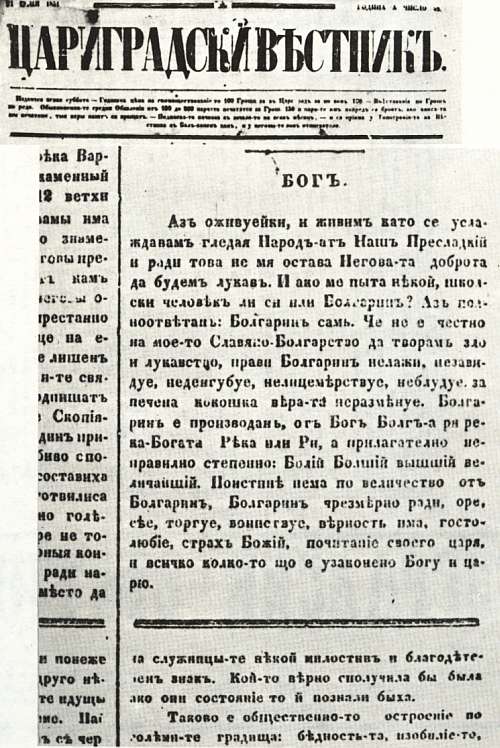
Coming back to life, I exist and I rejoice at the sight of our dear people and because of its goodnesss I cannot be cunning. And should somebody ask me whether I am a learned man or a Bulgarian, I would give him a full answer: ‘I am a Bulgarian!' Because it would not be fair to my Slav-Bulgarian origin to do evil and be cunning. The true Bulgarian does not lie, he is not envious, he does not run away from work, he is not hypocritical, he does not fornicate and would not exchange his faith for a roasted chicken. The word 'Bulgarian' comes from the word God (bog): bolg-arya'- 'reka bogata' (rich river), reka or ri, and the adjective is wrongly put in the comparative degrees: bolii, bolshii, visshii, velichaishii. And indeed, there is nothing greater than the Bulgarian. The Bulgarian is extremely industrious, he ploughs, sows, trades, fights, he is loyal, hospitable, God-fearing, has reverence for his king and everything that has been ordered by God and the Tsar. This is why I am a Bulgarian and my noble Bulgarian origin does not allow me to be bad. For this reason I have faith, hope, love and humanity and the ability to teach which I here share with my people, and he who wants an honest and unbiased teacher, here am I who speak with ardour, in a fiery way like Etna and Hekla and the volcano wrought a diamond wreath for me. Let me serve my people even if it should be un-pleasing to God. It is not honest of me - the Bulgarian, to fall into despair and to return evil for evil. The true Bulgarian is a loyal and noble man. The Bulgarian is an admirer of everything that is good. It is shameful for the Bulgarian to deny his kin and his language. That Bulgarian who blasphemes his kin has a name which is neither night, nor day. I am a Bulgarian and I weep for our lost Bulgarians who are in Lower Moesia1; for this reason we have to sacrifice ourselves for our brothers - the ever so dear Bulgarians.
В. „Цариградски вестник”, Цариград (The Bulgarian newspaper Tsarigradski vestnik (Constantinople newspaper), Constantinople, A, 44, July 21, 1851, pp. 174-175; the original is in Bulgarian
2 Lower Moesia (Moesia), Lower Bulgaria, South-western Bulgaria, etc., was called Macedonia to distinguish it from Upper Moesia, Upper Bulgaria, i.e. Northern Bulgaria, the region between the Danube and the Balkan Mountains
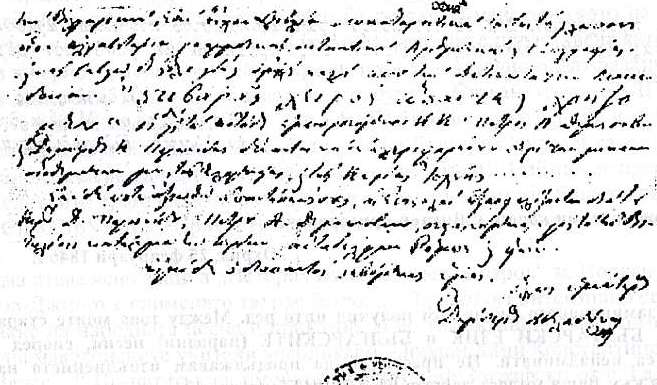
From a letter, written by Dimiter Miladinov and sent from Bitola to Alexander Exarch in Constantinople,
concerning the training of the Bulgarian children in their mother tongue
August 20th, 1852
May I be allowed to tell
you
of
some observations of mine, dating back to my childhood. In almost
six-eighths
of Macedonia, inhabited Bulgarians speaking the same language, all
study in the Greek language and are called
Greeks by the
Greeks, with the exception of the Slavs living further north who are
advancing
in the Slav language.
A Russian traveler, Victor
Grigorovich by name, a professor from Kazan, was very much surprised
when he
saw books in Slavonic in Ohrid, in my native town of Strouga, in Prespa
and
elsewhere, as if the Bulgarians living there had been unknown to the
European
peoples and had been considered another nation by them. When I taught
Thucydides in Ohrid, Grigorovich exclaimed with enthusiasm: 'Oh, but
are you
not our brothers?' as if he
were dreaming and did not believe that the Slav language was our mother
tongue
and the tongue of our forefathers. When the two of us arrived in my
native town
of Strouga the same evening, he expressed the wish to hear my old
mother sing
(a Bulgarian song), which he wrote down. He then asked me to write a
grammar of
the spoken Bulgarian language, which book be was waiting to receive in
Vienna,
where some Greeks and Albanians
from places around our country instigated by certain people,
accused him
unjustly of having stolen books, whereas in actual fact our
fellow-countrymen
had willingly given him some books.
Patriots! The torrent of
the
Greek
language will become irresistible in these parts, if resolute measures
are not
taken. There are many Slav-Bulgarians who have studied and are now
studying in
Athens, and as time goes by together with the language they acquire
habits,
and, as a result, nationality blends with-their feelings.
My brother, on his way back
from
Athens this summer, where he has been studying Greek philology at the
university for three years now, stopped at the monastery of Zograph in
Mt.
Athos to see hieromonach Parteni, who was once my student
and who has lately been studying in Russia. It had been my brother's
intention
to persuade Parteni to help him continue his education in Russia as a
student
of Slavonic philology. For the time being, however, he has only studied
Slavonic-Russian grammar and syntax at the monastery, and came back to
his
native town. And Parteni gave him this promise (if this happens to be
true):
'By working as a teacher, pay back, within three years, your
interest-yielding
debts (since we also paid for our studies with money, taken at
interest), and
after that I shall have the money to send you in three years' time to
one of
the universities in Russia.' From there my brother brought two books:
one with
church-songs in the Bulgarian language, and the other - a Bulgarian Gospel which he gave as gifts to my
native town of Strouga,
where, as my brother writes, every Sunday the Gospel is read in
Bulgarian by a
priest who speaks Slavonic, to the great satisfaction of the listeners.
At my suggestion, the Greek teacher in Strouga, a
former student of mine, and also priest Joan were persuaded to train
the students
in Bulgarian first. If they had text-books in that language, such as
primers,
grammars, syntaxes, arithmetics and geographies, I assure you that a
good
beginning would be laid in the most western part of Macedonia.
'We all need a strong hand.'
Mr. Peter M. A. Dimisovik and Dimiter K. Pagonidis, who engage in trade
over
there, can inform you of my humble feelings of patriotism and of Lady
Poverty.
If you will honour me with
an
answer, the delivery of the letters will be ensured by Mister D.
Pagonidis and
Peter Dimisovik, the address being the office of Brothers Robev and
Sons in
Bitola.
Very truly your:
Dimiter Miladinov
Братя Миладинови, Преписка (The Miladinov Brothers, Correspondence), Sofia, 1964, pp. 17 21; the original is in Greek;
A letter from Father Gerasim, abbot of the St Demetrius Monastery, Skopje district, to Alexander Exarch, Constantinople,
with a request for help for the Monastery
We, the poor monks from
Skopje, of
the Markov Monastery bearing the name of the holy martyr Demetrius,
have heard
of your generous hand which offers comfort and protection to the poor
Bulgarians; in all humility and awe we bow to your charitable shadow…
We, as the simplest of men,
will tell
you briefly about our Monastery:
1.
In 1844 it was burnt down by the fierce Albanians and
the new building was
reduced to ashes.
2.
During the
night they attacked the abbot, caught him and robbed him of all his
money, down
to the last coin.
3.
They plundered
church property, such as the chalice and the things which belong to it;
they
stole the priests' vestments and in the end, our dire need made us beg
of your
patriotic worship. We implore you to understand our anguish over our
having
become beggars...
We, who are forsaken and
far
away,
we plead, we appeal and we raise our voices even to the skies. Give us... so that we will have church vestments and
whatever... Go. .d wills! We pray to the holy
martyr Demetrius, and you know that he
does not hear our prayers. But appealing to God, we implore you for
help! What
are we asking for? Whatever you can do for us. Here we are, obedient,
submissive, hi tears, injured, oppressed, and burdened with all kinds
of
tortures, and as Christians, we remain your most humble slaves.
НБКМ, БИА, IIA 5361; the original is in Bulgarian
A letter from die residents of Gorna Djumaya (Blagoevgrad) to Matei, die metropolitan of Samokov, Constantinople,
in which they ask him to donate a certain sum to their school
With today's prayer we,
your
humble
children, enquire after your present state of health and well-being,
and we
wish to tell you how four weeks ago a Russian patriot by the name of
Mihail
Georgevich1 passed through our town. He stayed with us a few
days,
and he urged us to collect funds for the school, so that all the poor
children
of the town and countryside could study there. We are, at present, all
contributing to this righteous cause. The community, and each one of
us, is
helping according to his means. A certain sum has already been
collected from
the people from the district, and it is growing from day to day. And
the
Russian himself helped us as much as he could, and promised to get aid
from
elsewhere, too. And when the sum multiplies we shall pay the teacher's
wages
from the interest and the poor children will be able to study
comfortably, etc...
And as we, your humble
children,
young and old alike, kneel before Your Holy Archiepiscopal person as
representatives of our community, we beg of your Reverence and request
that
you, with your holy hand blessed by God, also help this enterprise,
pleasing to
God, and our community with whatever you deem necessary, with money or
with
things from some other schools... Now when your appointed
archdeacon Andronicus came to collect the taxes, we showed him the
school and
asked him to help us, but he told us to write to your Reverence. You
could tell
him what you deem necessary to contribute to our community. We want to
write to
you, as a good pastor of the community, and we all believe that you
will do
this. In the end, we humbly kiss your right hand and remain your
trustworthy
humble spiritual children. And when you answer us - please write a letter to us and another to the
archdeacon2.
НБКМ, БИА, IIA, 6892; the original is in Bulgarian.
1 Some authors suppose that it is A. F. Hilferding, which is hardly probable-
2 12 signatures follow from which we can clearly read the names of the manciple priest Mito, Stoimen Tsvetkov, Tasho Georgi, Stoitsa Kyurchi, Milos Spas, Marko Kyurchi, priest Andrea, priest Angel, Stoimen Stoyan, and others
A report from Koukoush about the introduction of the Bulgarian language into the schools and into the churches of the town
… It is with particular joy
and pleasure
that we are witnessing how national feeling is awakening also in areas,
in
which up till now it has been deeply slumbering, wholly suppressed
and stifled
by an alien feeling. Thus, several months ago, the Bulgarian language
was
introduced into the school and churches in Koukoush. What else could
this happy
event be but an obvious sign that the inhabitants of Koukoush have been
enlightened and have awakened, and have thus become aware of their
initial
delusion and of the false road which they have hitherto been following?
Until a short time ago,
the citizens of Koukoush not only had never heard the word of God in
their
native tongue, but the poor creatures knew nothing in that language,
and now
all of them, both young and old, listen with an unquenchable
thirst to the
word of God in their mother tongue; and all who are able to do so, have
started
learning to read and write in Bulgarian, and not only the young people,
but
also those already well advanced in years. Up till then the priests in
Koukoush
had known how to read only in Greek, a language which was entirely
alien and
unfamiliar to them, and now they realize and perceive the deep chasm
and abyss
in which they had previously dwelt; now they realize how far they were
from
their high office and title; because, calling themselves teachers and
mentors
of the people, they were not only unable and incompetent to teach and
advise
the people on the great, redemptive Christian truths, as was their
duty, but
they themselves also hungered and thirsted after these truths. It was
their
duty to enlighten the others, but how could they give enlightenment to
the
others when they themselves lived in utter darkness? Oh, indeed, what
an
extremely woeful and deplorable state of affairs! A similarly sorrowful
situation
still prevails even today in all the following Macedonian dioceses,
namely:
Ohrid, Bitola, Kostur, Moglena, Voden.Stroumitsa, Polyanino, Melnik,
Seres,
Drama and a few more, where the inhabitants intermingle with Greeks.
May God
bless the citizens of Koukoush, who are in the midst of the
above-mentioned
dioceses, to serve as an example to them with their awakening and
laudable
strivings! And this will doubtless soon take place, providing that the
zeal of
the citizens of Koukoush does not cool, and Koukoush will then become
the
centre from which love for public education will spread like lightning
in all
directions. And Koukoush will then be honoured and glorified not only
by the
people of today, but by our most distant descendents as well. This good
deed will
be indelibly inscribed in the history of the nation. And conversely,
everlasting reproach, shame and disgrace will fall on Ohrid, Bitola and
the
other major towns for their delay due to blindness and delusion.
Among the citizens of
Koukoush
Mr.
Nako Stanishev1 is outstanding in his zeal. And no less
immortal
will be the names of the teacher Dimiter Miladinov and his assistant
Xenophont2
for their devotion and zeal; they will be for ever remembered as the
first
propagators and disseminators of public education and enlightenment in
this
part of the country. The example of the citizens of Koukoush has
already been
followed, we gather, by their neighbours, the inhabitants of Polyanino3.Their
honorable priest, the monk Clement, is very active over there. May
God help
him! His activity is indeed truly spiritual and soul-saving. May God
grant us
more such priests, who do not always have their eyes on the purse! We
firmly
believe that the citizens of Polyanino will also show the same zeal and
unanimity concerning public education as their neighbours in
Koukoush.
The Bishop of Polyanino
(this
is
what they call the bishop of that diocese) was against the desire of
the
citizens of Koukoush to introduce the language of their forefathers
into the
schools and churches and told them that if they did not abandon 'this
innovation', he would anathematize them, but they/ат from
being afraid of such anathemas, gave him the following terse and very
clever
answer:
'Most holy Bishop, if we
are
introducing the Bulgarian language into our schools and churches, we
considered
that we are thereby doing not merely nothing bad, but on the contrary,
something which is pleasing to God and beneficial to the soul; because
the
Bulgarian language is our mother tongue, the only one we speak
correctly and
perfectly, whereas, on the contrary, as far as the Greek language is
concerned,
we do not understand a word, and the word of God, as is undoubtedly
clear to
every sober-minded person, ought to be preached in a language which the
congregation understands, otherwise the preaching could not be called a
sermon.
We see that the Divine Apostles, too, preached the Gospel to all
peoples not in
one language only, but to each people in their own language: to the
Hebrews in
Hebrew, to the Greeks in Greek, to the Romans in Roman, and so on, and
it
cannot be otherwise. And for what reason were the Holy Scriptures
translated
into all languages, if not so that each people would thus be able to
hear in a
language familiar to them God's Commandment and also the basic truths,
on the
knowledge or lack of knowledge on which their eternal redemption or
condemnation
and suffering depend? Then, again, for what reason, more than 1000 years ago, that is, immediately after the
Bulgarians were converted to
Christianity, were the Holy Scriptures translated into the Bulgarian
language
by Cyril and Methodius, with the consent and at the suggestion of the
Church of
Constantinople; was it
not so that the Bulgarian
people,
to which we belong, would thus be able to hear God's Commandment and
His lofty,
divine and redemptive truths, and to praise and glorify the Lord in
their mother
tongue? Our simplicity and delusion was die reason why hitherto we have
acted
unnaturally and against the law by totally avoiding the use of our
native
language in schools and in church. But you, Most Reverend Sir - being our spiritual father and shepherd, to whom
our souls have been
entrusted and for which one day you will have to answer before Christ
the
Shepherd and Commander - you should have already
long ago corrected this error and delusion of ours, that is to
say, you should
have made us listen to reason and see that we ought to pray to God in
our own
language, which you yourself should have learned to speak correctly and
perfectly in order to be able, hi accordance with your office, to teach
and
care for your spiritual flock. Whereas at present we are not able to
understand
you, neither are you able to understand us, and can you then consider
yourself
worthy of calling yourself our shepherd? That is why we beg you, Most
Holy
Bishop, if you will not take the pains and care to enlighten us and
lead us
along the right road in accordance with your calling, then at least do
not
stand in the way of our enlightening and educating ourselves both
spiritually
and intellectually, according to our ability and understanding.'
It was with
these words that the citizens of Koukoush shut the mouth of the bishop
and he,
willy-nilly, could say nothing, but evidently his heart was seething
with rage
and anger. May God teach him to be good! Amen!
Сп. „Български книжици", Цариград (Journal Bulgarski knizhitsi4) Constantinople, No. 10 May, 1858, p. 19; the original is in Bulgarian
1 Nako Stoyanov Stanishev (1810-1857), born in Koukoush, one of the first fighters for the Bulgarian national consciousness in Macedonia
2 i.e. Raiko Zhinzifov
3 i.e. the inhabitants of the Polyanino (Doiran) diocese
4 It was historico-philological in character; published in 1858-1862
From Veles (Macedonia) in May. I would like to tell you something about the present advance in Bulgarian education, especially in this town. In 1846 Veles began to wake up from a deep slumber and in this connection has now won a name for itself in the neighbouring towns and villages. A few patriotic and noble men revived in their fellow-townsmen that wonderful striving for education and knowledge, which for so many centuries had not been seen in Bulgaria owing to the Greek priests, whose desire it was to hold the Bulgarian people in the fetters of ignorance. But some patriots began to send their children to study in the major centres of Europe and helped a number of poor people's children to do the same; and this education awoke their national consciousness. This enthusiasm for national enlightenment grew, making gigantic strides. But, as is always the case, in Veles, too, there were people who were against these activities. Antim, the Archbishop of Veles, tried, together with his adherents, to impede these activities by saying that all peoples had got their education from the Greeks and it was therefore necessary to teach Greek and not Bulgarian in the schools, all the more so because the Bulgarian children learned to speak their own language while still at home. Obviously, Bishop Antim says this out of material interest, for otherwise, he could not be unaware of the fact that in Greece in schools they teach not in foreign languages but in Greek, their mother tongue, in spite of the fact that the children learn Greek while still in the cradle. Each nation should study the different sciences in their mother tongue, and afterwards, if they want to, they can learn all the languages in the world. This is the most natural and best method of education. Bishop Antim should not think that the citizens of Veles are so very simple-minded. They, too, are sons of that people, which had lain for long years in chains in Phanariot dungeons.
The newspaper Srpski Dnevnik, Novi Sad, No. 44, June 9, 1858; the original is in Serbo-Croat
A letter from a Russian official to Alexei N. Bekhmetev, Moscow, about the education of young Bulgarians at Moscow University
You were so gracious as to direct your benevolent attention to the fate of the Bulgarians, and many of them already profit from your really Christian participation in our educational activity. His Excellency Count Uvarov has expressed the beneficent desire to educate ten young Bulgarians at the Moscow Imperial University at his expense; in connection with this, two young men, born in this province, have been sent for from Macedonia: Konstantin Nakov, from Koukoush, a graduate of an Athens high school, and Xenophont from the town of Kostour1, a former teacher in Koukoush. Since twenty Bulgarians, eight of whom are Macedonians, had been accepted by the Odessa theological academy the above-mentioned young people are included in this number. Having had a certain amount of preparation, they wish to take advantage of the graciousness of the Russian monarch and to improve their knowledge at the University under your kind patronage. If it pleases Your Excellency to send for a few more Macedonians to continue their education at Moscow University, then on your orders, the Bulgarian archimandrite Parteni will be informed in Constantinople, who had been entrusted with selecting young Bulgarians to complete their education in Russia.
ЦГАОР, ф. 1750, on. 1, ед. xp. 67, л. 71-72; АИИ, БАН, кол. IX, on. 15, а.е. 67, л. 239-240; the original is in Russian
1 This refers to Raiko Zhinzifov, whose birthplace is mistakenly indicated as Kostour, instead of Veles. Raiko Zhinzifov (1839-1877) was born in Veles and was one of the leading activists during the National Revival period. He was an associate of the Miladinov brothers. In Moscow he edited the Bratski Troud (Brotherly Labour) magazine and contributed to Russian newspapers and magazines
A letter from Raiko Zhinzifov, Moscow, to G. S. Rakovski1, Odessa,
in which he announces his decision to change his Greek name to a Bulgarian one
'Blessed is the man who protects the apple of his eye', thus spake the wise Sirach. With these words embedded in my heart, I often reached for the pen with the intention of extending to you my deep-felt gratitude and of expressing the respect you inspired in me with the benefaction you lavished upon me. What, however, made me keep silent until now? No, Sir, no! Believe me, it is no ingratitude or negligence: the reason is known to you, which is that I was not at all certain that my letter could reach you in Odessa. But now, that I have found the appropriate time, I am addressing the present letter to you (although I still have my doubts) and with great delight, gratitude and respect, I dare give vent to my feelings in the following words:
You, wise Bulgarian hero,
Rejoice, you, wise soul,
Be glad, gentle soul.
You have earned honour and fame,
You have made an eternal name!...
Forgive me! My weak heart can say only this.
Do you remember when I came to Odessa and you heard my Greek name, your immediate reply was: 'You must change your name, if you are a Bulgarian!' Indeed, dear Sir, I cannot tell you how shameful my name seemed to me. Believe me, I was even ashamed to tell people my name... My curses on it!... Therefore, instead of Xnophont, I have chosen the name which D. H. Miladinov, a good and magnanimous man and the greatest patriot in Macedonia, gave me two years ago. This name will I keep to my last breath. Oh! If you only knew how happy I am and how proud!
I am sorry that I cannot offer you any information about the Bulgarians here, but paying my deepest respect to you, I remain your humble servant.
НБКМ, БИА, IB 1294/52; Архив Г. С. Раковски, обясн. бел. и ред. Никола Трайков (Archive G. S. Rakovski, v. 2, explanatory notes and editing by Nikola Traikov), Sofia, 1957, pp. 407-410; the original is in Bulgarian
1 Georgi Stoykov Rakovski (1821-1867), born in Kotel, a revolutionary democrat, a poet and journalist, leader of the Bulgarian national liberation movement, who maintained close connections with the leading figures of the Bulgarian Revival movement in Macedonia
Letter from Dimiter Miladinov in Koukoush to the Archimandrite Antim in the Zograf Monastery,
expressing his joy at the introduction of the Bulgarian language into the liturgy
My most reverend Father
Superior of
the Holy cenobitic monastery of Zograf, Antim, and the respected
fathers
dwelling with you.
It was with joy that I
received
your honoured letter of the 2nd of February, together
with the liturgical books which you sent for the local church. I read
it with
excitement and thought of the worthy successors of our late
forefathers, who
brought these glorious heirlooms of Bulgarian antiquity out of the
labyrinth and
preserved them in a flourishing state against Greek frost; and
moreover,
patriotism, striving for good, and the gigantic reconstruction to
improve the
monastery of St George are living phenomena, worthy of respect and
esteem, and
it is the duty of our compatriot-historians to write /about all this/
with the
pen of truth. It is from such priests-compatriots, who raise their
spirits to
the Almighty, respected in spirit and in truth, and who use their
intelligence,
that great gift of God to man, for every good deed which
contributes to the
welfare of their resurrected fellow-countrymen; it is from such
spiritual
fathers, I say, that our nation expects a return to its mother's milk
and its
moral awakening from the hibernating slumber of ignorance, into which
it had
sunk through Greek intrigues and wiles. And who could have expected
that, not
far from the gulf of Salonica (after the destruction of the Bulgarian
patriarchate and of the Slavonic literature which fell victim to
Hephaestus1,
as a result of Greek intrigues), who could have ever hoped that, in the
course
of one year and a half, the Macedonian Bulgarians would be listening to
the
whole liturgy and divine service performed in their mother tongue?
Could anyone
have ever imagined that Bulgarian children in Macedonia and Moesia
would be
studying in the secondary schools and universities in Petrograd,
Moscow, Kiev
and Odessa? Thanks be to the powerful protector and defender of the
whole of
Orthodoxy throughout the globe!
Experiencing the sweetness
of
their
mother's milk our fellow-countrymen in these places, like flowers in
early
spring in mountains still covered with light snow, are returning to
life, with
a spontaneous upsurge, in spite of being surrounded by the Greek
poisonous
snakes, pouring, like asps and cobras, their venom in this epoch mostly
against
the innocent and upright Bulgarians, loyal subjects of His Majesty the
Sultan.
Oh, how I regret the
indifference,
the ignorance and Graecomania in Strumitsa! How well it would be, if in
Strumitsa, using funds provided by some patriot, they could support
there a
Slav teacher to teach the young people their mother's milk.
The sly, but foolish monk,
the
Moldavian Wallachian yokel N/eophit/, teacher in the local school,
proved
clearly to be a viper lying in wait for innocent people under the
blossoms and
defiles the moral advance. Oh, how the respected fathers of the
Monastery of
Zograf suffered for years on end from his mean and sly Wallachian
behaviour!
Unlike him however, the
priest
Clement of Zograf still enjoys general respect and esteem, and, for his
appointment, all of us here must thank your high person and those
around you,
as you will see from the enclosed statement of the notables of
Koukoush, in
which they ask that he be promoted to the rank of archimandrite.
Братя Миладинови, Преписка (The Miladinov Brothers, Correspondence), Sofia, 1964, pp. 86-88; the original is in Greek
A petition from the Bulgarians in Koukoush to Pope Pius IX, in which they voice their discontent with the assimilative policy of the Greek Patriarchate in Constantinople and express their desire to join the Catholic Church
We, the undersigned,
residents of the diocese of Polyanino (Doiran) with great reluctance
and with a
deep and inexpressible sense of embarrassment in our souls, are
compelled to
admit before the whole world that our East Orthodox Church has sunk
into a
lamentable state that is beyond description. And our sorrow and
spiritual shock
are all the greater because our words prove that the evil has got the
better of
our forbearance. Alas! Those who should be the light and the source of
every
Christian virtue, i.e. our first spiritual shepherds and church
dignitaries, in
other words our bishops and archbishops, are trampling upon the laws
and the
sacraments of our Church.
...
Our people
do not receive the least spiritual benefit from them, and, in fact,
they suffer
from them both materially and morally, and they are exposed to great
temptation
by watching their depraved and unmonastic way of life. Briefly, such
bishops
are a heavy burden and a sore wound to the Christian fold. And our
Bulgarian
people suffer especially from this depraved Greek clergy... One of the most notorious of these licentious
and depraved priests is
our former bishop Meletius... We complained to the
Church on three occasions against this wolf in sheep's skin but no
one paid
any attention to our complaints...
Then, in order to preserve
our
faith whole and intact, as we received it from our forefathers, and to
preserve
ourselves from the dissipated and depraved Greek clergy, we have firmly
decided
to renounce them and to declare that we are ready to acknowledge His
Holiness
Pope Pius IX and his heirs to the Apostolic throne, as our religious
superiors,
under the following conditions:
…
2)
We desire
and consequently we implore Pope Pius IX to make no alterations in: our
religious rites and customs (ceremonies, festivities and the holy
service); in
the administration of the sacraments; in the position of our priests
and in the
language used in our churches, which is the old Bulgarian or Slavonic.
…
4)...
The
archbishop and the clergy who will be at the head of our dioceses and
parishes
must all be Bulgarians.
5)...
The
Bulgarian language with its national letters and characteristics must
be always
the principal language and the basis for the education of the young
people...
Thus we implore His
Holiness
Pope
Pius IX to receive us into his fold and under his wing... May God grant this, that He may be praised by us
and all the other Bulgarians!...
Йордан Иванов, Български старини из Македония (Yordan Ivanov, Bulgarian antiquities in Macedonia), Sofia, 1931, pp. 201 204; the original is in Bulgarian
A letter from citizens of the town of Strouga to Ilarion Makariopolski1, Constantinople, about the church vestments sent from Russia,
and about the success of the Bulgarian cultural and educational cause
We, the humble Bulgarians
who
have
signed this letter, citizens of the town of Strouga, Ohrid district,
most gratefully
received the following gifts sent to us by our dear mother /Russia/:
A. A few
months ago Georgeto /Georgi/ Moustrev brought church books, a
small set of 14 parts, but the service did not take
place because the Right Reverend, the Bishop -
our holy
Yoaniki, had fallen ill. Now we gladly took them and carried them into
our
church, and the Gospel, the Apostles, the holy service and the prayers
are
being read with great emotion, and gradually the entire service will be
held in
the Slavonic language. We request with Slav daring that you graciously
send us
a large set of 28 parts, because ours is a town where
church services are held every day, and the small set which we have
received,
we shall give to the village of Vishni. There is a priest from our town
there
who learned how to take the service in the Slavonic language, and he
now gives
blessings there. We also dare ask you for a support and a bell for our
church
as an eternal reminder.
B. A week ago
we received the priests' vestments which were sent by the
noble Grigori Paounchev from Ohrid. These were:
1.
A set of
vestments for the church, our house of the great martyr St Georgi, a
chasuble,
a stole, a belt, a set of sleeves and three holy shrouds.
2.
A deacon's
stole, a hymn book and a set of sleeves.
Honour and glory to God
most
high,
who permitted us, humble children, to come closer to our mother who had
forgotten us for a long time, and to regain our lost mother tongue, and
so that
God Almighty would enable us to taste our blessed mother's milk again.
God
grant! We are celebrating today, on the 25th day of the month of
November, with
prayers of the holy Clement, who, together with the venerable Nahum,
followed
Cyril and Methodius, our common Slavonic benefactors. And during this
glorious
celebration of St Clement, the priest wore the vestments that you
had sent us.
We celebrated and kissed the Gospel for the eternal glory of the Seven
Saints,
and secretly in holy secrecy, we mentioned the glorious names of our
compatriots, Bulgarian benefactors. Blessed be the name of our Lord
from now
for ever and ever. Amen.2
Архив внешней политики России, ф. „Славянский стол" (The Archive of Russia's Foreign Policy), 1860, 3915, л. З и об.; the original is in Bulgarian.
2 The letter is signed by 12 people, and is stamped with two seals - Joan, priest; Hristo, priest; Jovan Protopapa, Georgi, priest, Grigori S. Chakurov, Georgi Belev, Nahum Matov, D. H. Miladinov, Nahum Mara — church elder, Joavan G. Dorebanov, school elder, and others.
A letter from Alexander Rachinski, Kiev, to Alexei N. Bekhmetev, Moscow,
containing a request for securing state support to Konstantin Vezenkov
Since I know that three of
the
12 places for Bulgarian pupils in Moscow are still
vacant, I take the
liberty of asking your patronage for Konstantin Ivanov Vezenkov, born
in
Kroushevo, Macedonia; I willingly take it upon myself to recommend him
to Your
Excellency because I've known him since the days he was attending the
Bulgarian
school in Constantinople. He was sent to Russia by the new Bulgarian
Bishop
Parteni, who not long ago put an end to the
Uniate in Koukoush. It would be very kind of you if you were to enroll
Vezenkov
in a secondary school class corresponding to his level of knowledge, at
the
expense of the Moscow funds. This will greatly encourage Bishop Parteni
to
engage in useful activity in his new field in the Polyanino diocese.
Tonight I am leaving for
Odessa
because I want to catch the Saturday ship for Constantinople.
In entreating you for
useful
instructions and in recommending myself to the attention of Your
Excellency, I
remain with perfect respect and devotion, and have the honour to be
Your
obedient servant.
ЦГАОР, ф. 1750, on. 1, ед. xp. 67, л. 68; АИИ, БАН, кол. IX, on. 15, а. е. 64, л. 233-234; the original is in Russian
A letter from Egor P. Kovalevski, Moscow, to Alexei N. Bekhmetev, Moscow,
about the aid to be sent to the Bulgarian school in Koukoush
In thanking Your Excellency
for the
confidence which You so graciously showed me by enabling me to make the
final
decision as to where I should send the money which was first intended
for the
Bulgarian school in Koukoush, I consider it my duty to express the
following
considerations: we do not as yet know the number of the Koukoush
townsfolk who
have joined the Uniate, and what is more, we are justified in expecting
favourable results in connection with the appointment, on our
insistence, of
the Bishop of Doiran (Polyana), the Archimandrite Parteni, born a
Bulgarian, he
has the best references from all our agents who know him.
On the basis of this I
would
like
to propose that we should not, for some time, send the 2750 silver rubles intended for the Koukoush school
until we receive exact
information whether this school deserves such large-scale aid. If this
piece of
information proves to be unfavourable, we could try to send this money
to a
more useful and suitable place, asking for your permission in advance.1
ЦГАОР, ф. 175A, on. 1, ед. xp. 67, л. 69; АИИ, БАН, кол. IX, on. 15, а.е. 65, л. 235-236; the original is in Russian
A letter from the trustees of the monastery of St Nahum, Ohrid, written by Dimiter Miladinov to Ivan Denkoglu,1 Leipzig
about the introduction of the Bulgarian language in the school
It was with deep emotion
that
we
received the gold-brocaded mantle you sent for the holy shrine of St
Nahum
through the respected Mr. Hristo Manchev. We laid it on the holy place
where it
was so much needed and sang a holy service in praise of God. Your name
was
mentioned with respect and gratitude in our prayers and it was entered
in the
sacred annals of the monastery, as an eternal memory of the donor.
Such a gift from one of our
noblest
compatriots to the Slav monastery of St Nahum inevitably evokes the
most
pleasant memories of our forefathers. For us it is no ordinary present,
because
it reminds us of the lost precious treasures of our once glorious and
now
impoverished fatherland. This sacred gift reminds each of our
compatriots of
the ancient Slav splendour and encourages every sensitive man to return
to his
own true mother and suck sweet mother's milk.
After your gift, from other
compatriots, acting as benefactors of the whole Slav race, we received
through
Constantinople, several new vestments both for the priests and the
church, and
some Slavonic books and with these, on November 25,
last year,
when the holy memory of St Clement was commemorated, a brilliant,
solemn
service was conducted in the Metropolitan Church, and during the
procession of
the holy sacraments, the glorious names of the Slav benefactors were
mentioned
and one of the priests delivered a suitable short speech in Bulgarian.
To ensure the better
realization of
our good hopes, through the intercession of the Slav saints,
Clement, Nahum,
Cyril and Methodius, we have also appointed a teacher of our
resurrected mother
tongue to teach Bulgarian reading and calligraphy, and all our children
are
running to the school like lambs rushing to suck their mothers' milk.
Братя Миладинови, Преписка (The Miladinov Brothers, Correspondence), Sofia, 1964, pp. 104-106; the original is in Greek
A report from Ohrid to the newspaper Srpski Dnevnik concerning the demand
for a Bulgarian Bishop1
Bulgaria. We have received a letter from Ohrid dated February 4th, informing us that the Bulgarians there also are sick and tired of Phanariot management of the church affairs.2 The Bulgarians in Ohrid gathered together and agreed that they would ask for a Bulgarian bishop, and that, should the Patriarchate send them a Greek Phanariot, they would not let him enter the town, but would stone him. In connection with the same matter, they decided to send a delegation to Rome to ask for an archbishop from the Pope. They had already appointed the members of the delegation, but later decided first to inform the Patriarchate of their intentions. Their letter was received in Constantinople on the 19th of February. We shall see what the Patriarchate will say. Such are the consequences of the behaviour of the Phanariots.
Newspaper Srpski Dnevnik, Sovi Sad, No. 21, March 13, 1860; the original is in Serbo-Croatian
1 On the same question, in another report from Ohrid, the people of Ohrid inform the Constantinople Patriarchate that unless a Bulgarian bishop is assigned to them, they will recognize Pope Pius IX as head of their church. They ask for Ilarion Makariopolski (Srpski Dnevnik (Serbian Diary) newspaper No. 40, May 22nd, 1860)
2 Phanariots, i.e. bellicose supporters of the Greek Patriarchate, which had its seat in the Phanar district, of Constantinople
Our news from Bitola, May 12, could not be more pleasant. The local Bulgarians
have decided to
establish a Bulgarian library club in the town. They proposed, accepted
and
signed the following agreement for its establishment:
‘We, the undersigned, vow
to
support the establishment and maintenance of a Bulgarian library club,
which
will be supplied with newspapers and magazines in Bulgarian and other
European
languages and which will have a book depository with different
Bulgarian books
and other journals in various European languages.
Note 1) He
who contributes more than 500 piastres at the
beginning will become a founder-member of the library club and will
have the
right to vote on library club affairs for life.
Note 2) He
who pays 60 piastres a year will be an
associate member and will have the right to vote on library club
matters for
one year only.
When the necessary funds
have
been
collected, the regulations for the functioning of the Bulgarian library
club
will be drawn up.
This agreement was signed
by
the
town authorities and it will soon be put into action. It is said that
the most
active person in the realization of this project is Mr. Р Dimkov Radev,1 who studied in Athens
and Vienna. It is really
amazing and highly commendable that this young man has not lost his
patriotic
feelings in a town where we have had cause to lament the conversion
into Greeks
of so many of our compatriots. As for the library club we forthwith
give it our
approval and would advise the people of Bitola to persist in this
useful work.
В. „България", Цариград (Newspaper Bulgaria, Constantinople), No. 64, June 9, 1860; the original is in Bulgarian
A report to the newspaper Srpski Dnevnik on the celebration of the holiday of the Bulgarian and Slav alphabet
in Gabrovo, Yambol, Panagyurishte, Sopot, Veles and other places
Information about the
celebration
of St. Cyril and Methodius Day is arriving from everywhere. In Gabrovo,
Yambol,
Panagyurishte, Sopot, Veles and many other big towns there have been
celebrations in honour and praise of all the Bulgarian enlighteners and
men of
letters. These celebrations show the deep feelings which the Bulgarians
have for
their nationality and their eagerness for education; these celebrations
will
open the way to the prosperity of the Bulgarian people and this year's
celebration of St Cyril and Methodius Day -the
11th of May, will
remain forever inscribed in golden letters in the history of Bulgaria,
because
it was on this day that the majority of the Bulgarian towns awoke and
threw off
the Phanariot domination. It is certain that in the future this holiday
will be
celebrated with ever greater solemnity.
Otherwise I could again
inform
you
of fresh instances of the abuse of power on the part of the Phanariot
bishops,
who continue to rob while they can. Such are the complaints from the
citizens
of Bitola, Ohrid, Samokov and other places against their Greek bishops.
The
bishop of Ohrid, in particular, is simply intolerable. But, if God
wills, this,
too, will pass.
Newspaper Srpski Dnevnik, Novi Sad, No. 46, June 12th, 1860; the original is in Serbo-Croat
The newspaper Srpski Dnevnik on the malpractices of the Phanariots and the strong determination of the Bulgarians
to win independence for their church1
From Bulgaria. June 7th ... The Bulgarians in Adjar have also celebrated St
Cyril and Methodius day.
On Sunday, the 29th of May, the Bulgarians in Pirot omitted the name of
the
Phanariot bishop from the holy service and instead they mentioned
the names of
the Sultan and Bishop Ilarion in their prayers. All the Bulgarians are
surprised that there is no similar news from Skopje, Vranya, Vidin and
some
other larger Bulgarian districts.
...
From
Bulgaria. June 10th ... The Bulgarians in
Karnobat omitted the name of the Phanariot bishop from the holy service
and the
citizens of Kotel wrote to their 'beloved' bishop Veniamin, telling him
to stop
visiting them. We are informed from Bitola (Toli monastery) that the
Bulgarians
there have decided to establish a library club. Most active in the
realization
of this project is said to be Mr. Р
Dimkov, who has studied
in Athens and Vienna. It is really excellent and praiseworthy that he
has not
forgotten his nationality while studying in a town, where so many of
our
Bulgarians have been converted into Greeks ...
Newspaper Srpski Dnevnik, Novi Sad, No. 50, June 26th, 1860; the original is in Serbo-Croat
The newspaper Srpski Dnevnik reports that the Bulgarians in Ohrid are rejoicing at the break with the Patriarchate in Constantinople
From Bulgaria. July 9th. The Easter events in the Bulgarian church in Constantinople have practically everywhere made an impression to a greater or lesser extent. There is not a single Bulgarian patriot whose heart does not throb with joy on seeing that the Bulgarians have awakened from their deep and long slumber and are demanding a church hierarchy of their own. The Bulgarians in Ohrid, the ancient seat of the Bulgarian Patriarchs, were in extasies when they heard about the action of their compatriots in Constantinople. All the efforts of their Phanariot bishop Melenti were in vain, it was precisely this that made the people love the Bulgarian hierarchy all the more. All his complaints to the Vali of Bitola are of little avail.
Newspaper Srpskt Dnevntk, Novi Sad, No. 59, July 28th, 1860; the original is in Serbo-Croat.
From a letter from Ivan C. Vukadinovic,1 about the accusations and slanders against him by the Greek coadjutor, and the desire of the Bulgarians to break with the Patriarchate in Constantinople
We have been requested to
publish
the following statement:
A priest, a Bulgarian, who
acknowledges the Pope and not the Greek Patriarch as the Head of the
Church,
answers the abuses directed against him by the coadjutor of the Bishop
of
Bitola in the Greek church there before the whole congregation. As an
Orthodox
uniat, i.e. a man acknowledging the Pope, but observing the Eastern
Orthodox
rites, he has, for several months already in the French Church in
Bitola,
conducted the service in the Bulgarian language and manner, and has not
allowed
a single Sunday or a holiday to pass without his preaching a sermon to
the
people. The Bulgarians in Bitola do not attend any other church but
that in
which he reads the holy service and his sermons in their native
language, so we
are informed.
The Greek bishop, unwilling
to
lose
his prestige in the town, thought that if he hurled vituperations and
nonsense
against that priest in church before the congregation the people would
take
heed. But this wretched Greek does not know, our letters say, that the
eyes of
the people are already opened and they are able to distinguish the
truth from
the lie, and the more the Greek bishop endeavours to sever the people
from that
priest, the more closely these people stick to that priest of the
people.
That the intentions of this
priest
are good - and we sincerely wish him success
in their realization - is clear from his answer
to the Greek coadjutor. Let the readers read it and they will see that
we are
speaking the truth.
Mr. Editor of the Newspaper
Bulgaria!
On Sunday, August 28th, the
Greek
coadjutor Stefan, at the instigation of
his bishop Benedictus, took the liberty of abusing me in public,
telling the
people in church various lies and slanders against me - a true priest -
and he went so far as
to
pronounce an anathema against all who would dare to attend my liturgy
or listen
to my sermon. First he said that I was not a priest, that I was a
protestant,
and that it was my aim to convert all Christians from the old creed to
which
all saints adhered. He also said that I had asked the Greek bishop to
allow me
to serve in the Greek Church but that he had refused. He blamed me for
having
no beard, and finally alleged that I used pomade.
To these nonsensical and
outrageous
slanders I feel obliged to answer: Brother Bulgarians! You must know
and be
quite sure that the anathemized Greeks are still misleading and
deceiving you
as they have been doing for 400 years. Do you not know
that the Bulgarian people number 5,000,000,
while the Greeks are
only about 2,500,000? Or, in other words, the Bulgarians
are twice as many as the Greeks. The whole world wonders how it is
possible
that a people such as ours could fall under a nation which is our
inferior
both hi numbers and strength. Secular history tells us that the
Bulgarians
defeated the Greeks on many occasions and that the Greeks paid them
taxes for a
considerable time. It will now be asked how the small Greek nation was
able to
subdue and trample underfoot a nation as glorious and great as the
Bulgarian.
It is easy to answer this question: the Bulgarian people has always
been
industrious and God-fearing; but the Greeks are cunning and in full
agreement
among themselves. The Greeks with their cunning, obstacles and snares
have been
able to catch in their net not only the Bulgarians but even the
Russians, the
Serbs and the Wallachians, as it will be clearly seen from the book I
published
in Vienna. The Greeks seceded Christians from the blessed church union
with
false arguments, in order to obtain for themselves power over the
Church. And,
after enticing the Christians under their religious domination, they
began, by
means of speculation in the name of religion, to assume some secular
authority
over the Christians as well, thus subordinating the Bulgarians to their
yoke.
This is why they have suppressed the Bulgarian liturgy, this is why
they have
burned Bulgarian books and other valuable written documents, this is
why they
have persecuted the Bulgarian schools, the Bulgarian Patriarchate, the
Bulgarian bishops, priests and other Bulgarian clergy whom they have
humiliated
and rudely overthrown; and thus the Bulgarians lost their own liturgy
and
bishops, and, finally, might have lost their language, too, had not the
people
awoken and declared their nationality. The insatiable, avaricious and
predatory
Greek patriarchs intended to do the same with other nations as well,
but these
nations broke away from them.
The insatiable cupidity
of the Greeks has always made them eager to fill their purses, and the
wretched
Bulgarians are to this very day enduring fines, dishonour, injustice
and the
bitter persecutions at the hands of the Greek bishops. The Greeks have
forsaken
and disgraced the Christian Law, they have violated and abandoned the
sacred
canons of the holy father and they are hourly committing
numberless
transgressions not only rejected by the sacred canons of the church but
even
anathemized as you will see below.
My Bulgarian brothers! All
peoples
hold their nationality dear, they labour and endeavour to educate
themselves
and enrich themselves with schools and sciences, therefore I think
that, after 400 years of ignorance, you will also
recognize your true creed and
nationality and will not remain among the most wretched nations in the
world.
My aim is to awaken your national spirit, and then, after your eyes and
ears
are opened, to purge and cultivate your tongue. But until you have
thrown off
the accursed Greek yoke, until you have regenerated your national
language - you must unite and together break
away from the Phanariot Greeks, who
are sucking your blood. Just as every bird sings and praises God in its
own
voice, so also you should praise God in your mother tongue, praise God
with a
liturgy in the Bulgarian language and listen to the words of God every
Sunday
and every holiday in Bulgarian, which you are not able to do in the
Greek
churches. Christ, our Saviour, sent the Holy Ghost to the Apostles in
order to
teach them to speak all languages and to enable them to teach all
people how to
praise God in their own language. The Bulgarian people, while they had
their
liturgy in their own language and their own Patriarchate, were famous
and
glorious, but ever since the Greeks brought you under their yoke, you
have lost
your former glory, and Europe has completely forgotten you.
Therefore you must
shake off this rust and look with the eyes of the spirit. Listen to my
voice,
listen to me, because I have come among you to lead you along the happy
road to
salvation. But, brothers, you have to unite and break away from your
enemy, and
then your kind, merciful and just king - Abdul Medjid will heed
your voice and grant your request, because he knows that you have
always been
his loyal subjects. Come to me, my Bulgarian children and brothers, and
listen
to me, because I shall teach you the true faith...
В. „България", Цариград (Newspaper Bulgaria), Constantinople, No. 80, August 28th, 1860; the original is in Bulgarian
A petition to the Sultan from representatives of different towns and villages, gathered at the fair in Ouzoundjovo,
declaring that they renounce the Patriarchate,
desire Bulgarian bishops, and recognize Ilarion Makariopolski as the head of their Church
The undersigned Bulgarians,
most
loyal subjects of Your Imperial Majesty, kneeling at the foot of
Your throne,
meekly submit this humble petition:
Owing to the long-standing
oppression of our people by the Greek clergy, who have unlawfully
usurped our
church hierarchy, your slaves, the Bulgarians, in many places have
sent your
honoured Government petitions for the re-establishment of out forgotten church
hierarchy, but our
enemies, wishing to prevent the realization of our just desire
constantly
conspire and assert that this movement is the private work of a few
individual
Bulgarians only. Since the interests of the people from different parts
of the
country have gathered us here, and since we are fully convinced of the
constant
endeavours of Your Majesty to ensure the prosperity and welfare of all
your
subjects living within your god-loving Empire, and of your daily mercy
to us,
your loyal subjects, we venture to declare in our humble petition to
Your
Imperial Majesty that the re-establishment of our usurped church
hierarchy is
the unanimous desire of all Bulgarians, the loyal subjects of Your
Imperial
Majesty, and we humbly petition Your Majesty for the
re-establishment and
recognition by our highly esteemed Government of our church
hierarchy under
the religious leadership of the head of our Bulgarian church in
Constantinople
Ilarion. We further wish to inform Your Imperial Majesty that we, your
slaves,
have renounced the Greek Patriarchate and no longer recognize the
bishops,
forcibly imposed on dioceses inhabited by Bulgarians. We want the head
of our
church to be a Bulgarian and we want our dioceses to be given Bulgarian
bishops, elected by the people, according to the laws of our
church, because
they are of our nationality and know our language, and because we don't
like
Greek bishops.
This was and still is
the desire of all your Bulgarian subjects and we shall not stop
imploring your
royal mercy, until our desire is granted, and, relying on the
magnanimity of
Your Imperial Majesty, we hope that our request will granted, and with
uplifted
hands we pray God for the health and long life of Your Imperial
Majesty, and
for the strengthening of Your Imperial throne, for the preservation of
which we
are ready to shed the last drop of our blood, we remain forever devoted
to your
paternal royal mercy, and we are glad to call ourselves:
The most loyal slaves of
Your
Imperial Majesty:
Turnovo - 46
Sliven - 74
Zheleznik
(Stara Zagora) - 86
Kazanluk - 38
Karlovo - 38
Sopot - 46
Svishtov - 9
Vratsa - 17
Pleven - 14
Haskiyu - 48
Pirdop - 6
Tryavna - 38
Mirkovo - 3
Adjar - 7
Roushchuk - 11
Shoumen - 10
Kotel - 8
Zheravna - 3
Samokov - 17
Kalofer - 71
Chirpan - 13
Kirklisia (Lozengrad)
Lovech - 20
Pazardjik - 14
Koukoush - 4
Panagyurishte - 5
Skopje - б
Ohrid - 17
Veles - 8
Nevrokop - 1
В. „България", Цариград (Newspaper Bulgaria), Constantinople, No. 81, September 5, 1860; the original in Bulgarian
A newspaper report from Ohrid states that two Bulgarian schools have been opened in the town and
that the population of Ohrid desires Ilarion Makariopolski as bishop
Here in Ohrid Slavonic
studies
were
for a very long time extinguished. But for 2 years now we have begun
to study Bulgarian. And praise be to God, the students are advancing
very well
in everything, in their studies and in their writing, but more so in
writing.
We are very proud of their good writing in Bulgarian and we hope it
will be
still better in the future. We are very glad to have our Bulgarian
school and
since God has given us such a good priest as Apostol Sokol from
Koshishta, all
the poor people rejoice because he opened a second Bulgarian school
here. We
have two Bulgarian schools now and the students are getting on with
their studies
very well, only we stand in great need of books since we have very few
of them
and sometimes ten students have to study from the same prayer-book and
the same
is true of other books here in Ohrid. All our Bulgarian brothers here
support
the Bulgarian school because they have seen that their children are
advancing
steadily, and in these last two years of studies in their native
language they
have learned as much as they do in ten years study in Greek.
We now pray that with God's
help,
things are going to improve further. And only in Mesocastro the priest
Stefan
Giurche is loudly crying against the Bulgarians in the church, but even
so, he
will give up very soon, because he himself is a Bulgarian, and a
teacher for so
many years now, and this is the reason why he is able to scold us. But
in a
short time we shall have our own children as teachers, so the priest
Stefan
will remain without this job, and he doesn't like it. And we have begun
to sing
in Bulgarian in our churches and our hearts melt with joy when we hear
our own
language there. Formerly, if we didn't say 'kirie elleison'1
in
church, we were sure to have great troubles. Now we shout: 'Lord have
mercy
upon us' at the tops of our voices, and even the little children
sing together
with us. At present we have no bishop here in Ohrid, or rather there is
one,
but he stays in Kroushevo now. Formerly he was a coadjutor to the
bishop here
and for ten years served faithfully Bishop Dionissius, who made him
bishop in
Kroushevo. But soon after, he was sent to Bosnia, while Dionissius went
to
Kyustendil. We had another metropolitan - Mr. Yoanikius who
came from Elbasan, but he died soon afterwards and his place was taken
by Mr.
Milenti, who came from Bosnia. But the latter, when he was coadjutor,
didn't
know what the poor folk should do, and when he visited us on Easter, no
one
showed him any respect, and for this reason he is staying in Kroushevo
now. We
told him to mind his business there, because we wanted a Bulgarian as a
metropolitan and not a Greek. He told us that he also knew the Slav
language
and that he was ready to use Bulgarian in church. But we told him we
were
expecting Ilarion and not him, and that many Greeks had sucked our
blood and
that we no longer wanted Greek bishops. So he is now staying in
Kroushevo and
let you /Ilarion Makariopolski - editor's note/ come from
there to Ohrid.
В. „Дунавски лебед", Белград (Newspaper Dounavskilebed2),Wo. 5, Oct. 12th, 1860, Belgrade; the original is in Bulgarian.
2 Socio-political newspaper edited by G.S. Rakovski (1860-1861), and expressing the strivings of the Bulgarians for national liberation
Dear Sir,
Some weeks ago I received
two
copies of the first issue of your newspaper, and five days ago I
received the
other issues up to the fifth.
I did not write to you
earlier
because I had been very busy. Now it is my pleasure to answer you.
I am very sorry that I
cannot
rejoice you with new subscribers, but I hope to enroll the Holy
Archbishop of
Polyana (Doyran) as a subscriber. Today I shall send the issues to
Koukoush.
Later I might be able to enroll some one else.
I feel great sorrow that,
although
I am a Bulgarian, I do not know how to write in the Bulgarian language.
I have
been living in this city /Salonica/ for 10 years now, and I have a
press where I publish all the Greek books introduced in the schools,
but I
helped, as was proper, the Bulgarians in Koukoush who wanted to have a
Bulgarian bishop - Partenius. The Greeks, especially
the notables, together with the Metropolitan of Salonica and Voden,
made
representations to the Pasha /the district governor/, and six months
ago they
closed my press. And now I have only my bookshop. The question was
referred to
the Ministry in Constantinople. I have friends there, but there are
also people
who are against me. The result is not yet known to me. The Greeks, of
course,
backed up by the clergy and the authorities, strongly attacked the
Bulgarians,
though the latter are acting within their rights, voicing their desire
to
develop and make progress in their mother tongue. Even though I have no
/written/, command of this language, I have always spoken in favour of
its
dissemination among the Bulgarians. The teaching of Bulgarian greatly
helps the
studying of Greek. Even if I were a Greek, I would have maintained
this.
However, few people are not biased, and that is why we are considered
the ones
to blame.
On his return from Moscow
in
August
Georgi Dinkov passed through our town. Perhaps you met him. He is my
nephew,
that is, the son of my brother Konstantin Dinkata. With my assistance
he was
sent to Russia two years ago. He entered a school (seminary) in
Smolensk, where
he is studying on a state grant.
There is nothing new here I
can
write to you about, except the persecution and torture of Christians.
The civil
authorities and the clergy, with a few exceptions, are all
occupied solely
with looting and plundering. No care is taken to improve the
Christians' lot.
In vain the Europeans shout, in vain the ministers write, in vain the
journalists publish news of robberies and murders — the Turks remain indifferent. I have no time to
write to you in greater
detail.
Архив Г.С. Раковски НБКМ, БИА, IB 1166/52; (Archive G. S. Rakovski), vol. 2, explanatory notes and editing by N. Traikov, Sofia, 1957, pp. 622-625; the original is in Greek.
A letter from Konstantin Petkovich, Dubrovnik, to Stefan Verkovic,1 Seres, in which he thanks Verkovic
for the collection Folk Songs of the Macedonian Bulgarians
It is an especially pleasant
obligation for me to express to you my sincere and heartfelt gratitude
for your
present, precious and dear to my heart, which you were kind enough to
send me - the book entitled Folk Songs of the
Macedonian Bulgarians. This
is the most gratifying way of reminding me of the pleasure of having
made your
acquaintance in Constantinople in 1851
which I have never
forgotten. Thank you for your present from the bottom of my purely Slav
heart.
Your collection of
Bulgarian
songs
is of great importance at the present time, when our literary language
has not
yet been finally established, and every writer is twisting it and
correcting at
will. I maintain that in Macedonia, that is, round Bitola, Ohrid and
Veles, one
can find Bulgarian songs and tales in a language that is even purer. No
doubt,
the Bulgarians living now in Macedonia are the true heirs to those
Slavs for
whom St St Cyril and Methodius translated the Holy Scriptures.
Once again I extend my
gratitude to
you. I am at your service and I shall do anything I can for you.
БАН, НА, ф. 14, on. 1, a.e. 247, л. 1-2; Документи за Българското възраждане от архивата на Стефан И. Веркович. Съст. и подг. за печ. Д. Велева и Т. Вълов, под ред. и с предг. чл. кор. Хр. Христов (Documents of the Bulgarian Revival Period from the archive of Stefan Verkovic. Compiled and prepared for publication by D. Veleva and T. Vulov, edited and prefaced by H. Hristov, Corresponding Member of the Academy of Sciences), Sofia, 1969, p. 19; the original is in Serbo-Croat
1 Stefan I. Verkovic (1821-1893), born in the Bosnian village of Ugljara. In 1850 he settled in Eastern Macedonia. He cherished deep sympathy for the Bulgarians and actively participated in their national-liberation movement. He published Narodne Pesme Makedonski Bugara (Folk Songs of the Bulgarians of Macedonia) (1860), Opisanie Bita Bolgar Nasselyayushtih Makedoniyu (Description of the way of life of the Bulgarians in Macedonia) (1868), and others

A letter from Kouzman Shapkarev,1 Ohrid, to G. S. Rakovski, Belgrade, about the schools and churches in Ohrid and Strouga
The rumour of your true
patriotism
and of your constant endeavours to assist the progress of our people,
which has
spread through the air, which has reached the high mountains, deep
valleys .and
green fields all over Bulgaria, has also come to our once glorious town
of
Ohrid (Prima Justiniana), and it has at last reached our ears for which
we
offer thanks to God most high. We rejoice with inexpressible Bulgarian
feelings
of happiness. We have had the honour, in the days of our most
magnanimous and
merciful Sovereign, Sultan A (bdul) M(edcid), of seeing such
magnanimous and
truly wise men who are trying to awake our people that are sunk in deep
sleep.
God grant!
With the present letter I
also
have
the honour to introduce myself to your honorable person. I am happy to
be a
Bulgarian, a citizen of the town of Ohrid, living in the Varosh - the central part of Ohrid, surrounded by a
fortress wall and consisting
of seven streets, containing the bishopric, the church and the holy
relics of
St Clement, the archbishop of Ohrid, and other antiquities. And so I
was
appointed teacher in the Varosh schools, teaching Greek and knowing a
little of
our own tongue. Two or three years ago, when I was in Strouga, a little
town
near Ohrid, I introduced our language in the local school and in the
church
services for the first time, and now the children study both Greek and
Bulgarian, and church services are held only in the Slavonic language.
Later,
occupying a teaching post in our schools, I tried to introduce our own
tongue
into them too, and we have made several attempts, but I could not
introduce it
wholly. The Phanariots have acquired a very great influence through
intrigues
and slander. They are aided in this by a certain priest Stefan
Byurchev, a
former teacher of Greek in the Mesokastro school, and a rabid
Hellenist, for
which he was expelled from the school, a regular Phanariot.
For two years I have been
engaged
in collecting some folk songs, of which I have up till now collected a
hundred
and more. I want to publish them, but, not having the means, I keep
them under
lock and key. There are all sorts of songs among them, but mainly
women's
songs. First, all the songs which are sung in our town, especially in
the
Varosh, with descriptions of all the customs, the way they are
performed and
what songs are sung on every single occasion, etc. Last year on March
the 25th,
at a poetry competition held in Athens, the prize went to a poem called
'The
Sirdar.' Its author was a compatriot of ours by the
name of Grigor Krustovich Purlichev,1 who signs himself
G. Stavridis. His poem was based on the heroic deeds of one of our
fellow-countrymen, called Kouzman Kabidana. I have also written down
how this
song is sung, together with some notes about his poem 'The Sirdar,'
notes which
will be of use to our people.
If it is possible and
convenient
for you, let me know in some way if someone could finance their
publication,
and send 60 copies to me, so that I could
distribute them here. If it is possible, please let me know in March,
when our
fellow townsmen will go there, so that I can send the songs to you
through
Yannet A. Chapakov or someone else. After which I hope to collect some
more of
the same type, or heroic songs, which are not sung here in the town,
but are
very popular in the villages, where I shall collect them.
You had asked one of our
fellow
townsmen, Mr. Yovancho Georshevik Belev, to collect folk songs. He is a
sincere
and hardworking man, but this is no job for him.
Please write to me about
any
subject which concerns our lands, and I will do my best to write to you
about
it.
I shall ask you something
else,
too, if possible. We rejoice in the progress of our people, but we have
no way
of learning about it. It your honourable person could oblige us,
please send
us an issue of Dounavski Lebed - we call it 'labed'
(Danubian Swan) to the following address: 'Ohrid, the Varosh school,
for the
teacher Kouzman Anastassov Paskhalov.'
It is on purpose that I am
writing
to you in our dialect, so that you can learn how we speak here, which
you will
also see in the songs. With apologies for being a nuisance, I have the
honour
to cherish the deepest veneration for your patriotic Worship.
НБКМ, БИА, IB 1294/52; Архив Г.С. Раковски (Archive G. S. Rakovski), v. 2, explanatory notes and edited by Nikola Traikov, Sofia, 1957, pp. 794 797; the original is in Bulgarian
1 Kouzman Shapkarev (1824-1909), born in Ohrid, one of the outstanding figures in the Bulgarian National Revival movement in Macedonia
2 Grigor Purlichev (1830-1893), born in Ohrid, an outstanding Bulgarian Revival figure and poet. In 1860 he took part in an anonymous competition in Athens and won the prize with his epic poem The Sirdar.
1861
2. Stanishev from Plovdiv (Philippopolis)1
3. Diamandiev from Ohrid
2. Todorov frojn Lyaskovets
3. Lyuben Karavelov from Koprivshtitsa
4. Panov from Braila
5. Zhinzifov from Veles
6. Fangov from Kalofer
2. Stoyanov from Voden
2. Karakonov from Lovech
2. Vezenkov from Kroushevo (
3. Hristov from Gabrovo
4. Petko Karavelov from Koprivshtitsa
ЦГАОР, ф. 1750, on. 1, ед. xp. 341, л. З АИИ, БАН, кол. IX, on. 15, а.е. 145, л. 548; the original is in Russian.